
Students completing the International Baccalaureate (IB) Diploma Programme often consider universities in different countries when planning their next academic step. Belgium can be an attractive destination because it offers internationally recognised universities, a multicultural environment and degree programmes across a wide range of subjects.
But can you apply to Belgian universities with an IB Diploma? Yes. The full IB Diploma is recognised by several Belgian higher education institutions as an eligible secondary-school qualification. However, acceptance of the qualification does not automatically guarantee admission to every university or degree programme.
Students must also consider subject requirements, academic results, language proficiency, application procedures and any additional entrance assessments.
Whether you are interested in economics, business, engineering, sciences or humanities, understanding these requirements early can help you prepare a stronger application.
Is the IB Diploma Accepted by Belgian Universities?
Yes. Belgian universities recognise the International Baccalaureate Diploma Programme, although the application process and additional conditions can differ between institutions.
For example, the University of Antwerp allows students with an accredited International Baccalaureate Diploma to enrol in academic bachelor's programmes, provided the qualification can be verified through the IB's official records. Students who require a visa must still follow the university's admission application procedure.
KU Leuven also lists the IB Diploma Programme among the qualifications that meet its minimum eligibility criteria for bachelor's applications. Individual programmes may have further requirements, including mathematics preparation or language proficiency.
In French-speaking Belgium, institutions such as UCLouvain and Université libre de Bruxelles recognise the Geneva International Baccalaureate as a qualification that can provide access to higher education.
This recognition makes Belgium a possible destination for students completing the IB Diploma in the Netherlands, the UK, Singapore, the United States or another country.
However, students should always check the latest requirements on their chosen university's official admissions website.
Understanding Belgium's Higher Education System
Belgium has different education systems across its linguistic communities. Understanding these differences is useful because the language of instruction and admission procedures can vary.
1. Flemish Community
The Flemish Community includes universities in the Dutch-speaking region of Belgium. Some institutions also offer programmes taught in English.
Examples include:
KU Leuven
Ghent University
University of Antwerp
Vrije Universiteit Brussel (VUB)
Hasselt University
International applicants generally apply directly to their chosen institution. The university evaluates their secondary qualification and checks whether they meet the programme's additional conditions.
2. French Community
The French Community includes universities in Brussels and Wallonia. Many undergraduate programmes are taught in French, although English-language opportunities are available in certain fields and at different study levels.
Examples include:
Université libre de Bruxelles (ULB)
UCLouvain
University of Liège
University of Mons
The Geneva International Baccalaureate is among the qualifications recognised for access to higher education in this community. Students should still check the relevant programme and application instructions.
3. German-Speaking Community
Belgium also has a smaller German-speaking education system. Students considering institutions or programmes in this region should check the language of instruction and the specific admission route.
The important point is that Belgium does not have one identical admission process for every university. Applicants should identify their preferred institution and follow its own instructions.
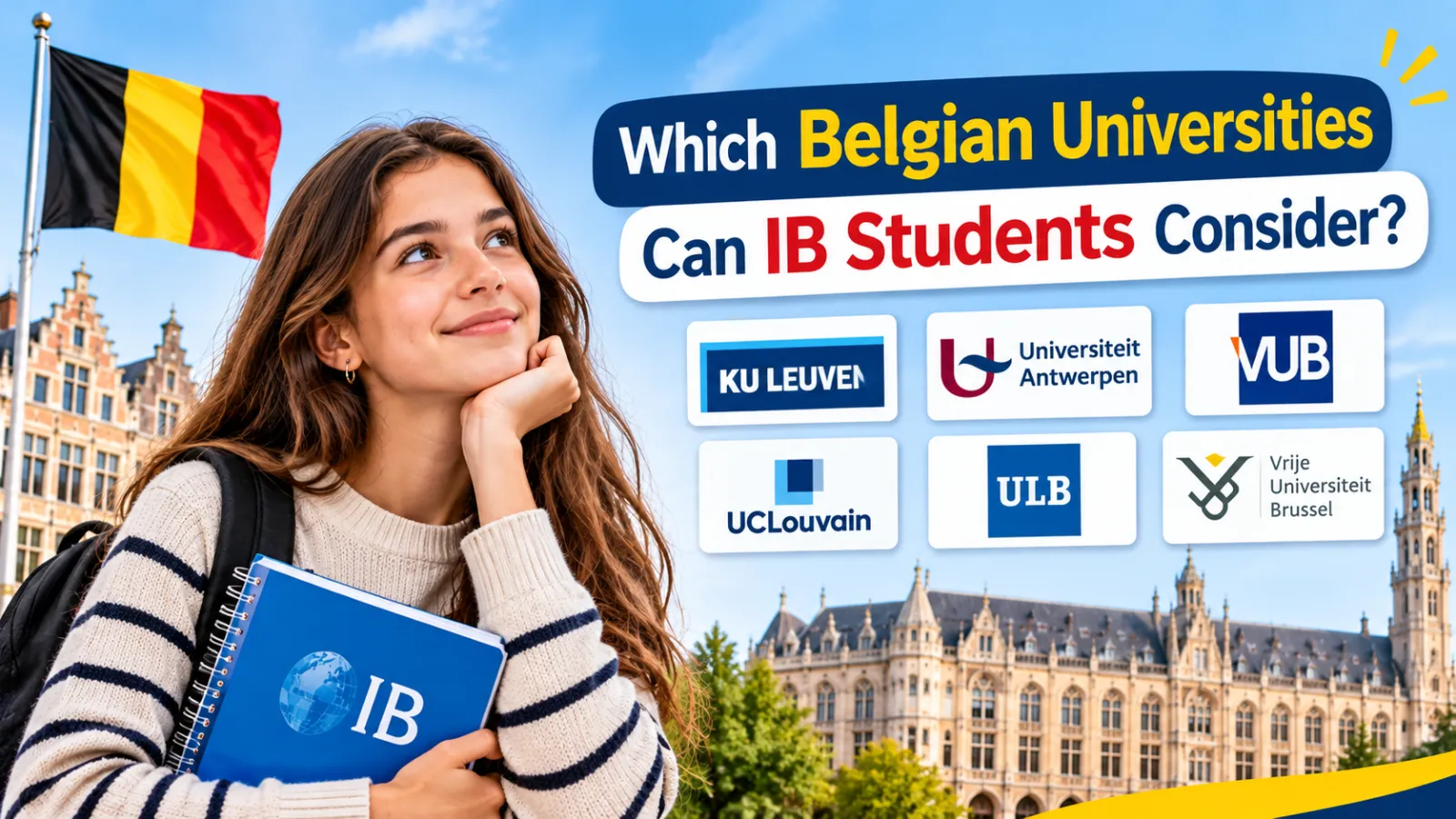
Which Belgian Universities Can IB Students Consider?
Several Belgian universities publish admission information for international applicants holding an IB Diploma.
KU Leuven
KU Leuven is one of Belgium's established research universities. Its admissions guidance includes the International Baccalaureate Diploma Programme among the qualifications that can meet the minimum eligibility criteria for bachelor's applications.
However, students should not assume that meeting the general qualification requirement is sufficient for every course. Individual programmes can request additional documents or evidence of subject preparation.
For example, applicants to certain business or economics-related programmes may need to demonstrate an appropriate level of mathematics and English proficiency.
University of Antwerp
University of Antwerp accepts an accredited International Baccalaureate Diploma for direct enrolment in academic bachelor's programmes under its published conditions.
The university states that the diploma must be verifiable through the IB's official records. Students who need a Belgian student visa must also follow the applicable admission application process.
Vrije Universiteit Brussel (VUB)
Vrije Universiteit Brussel accepts applications from students with international secondary qualifications.
Applicants should review the university's academic and language requirements and check the conditions for their chosen bachelor's programme. Some courses have additional subject or selection requirements.
Université libre de Bruxelles (ULB)
Université libre de Bruxelles recognises the International Baccalaureate awarded by the International Baccalaureate Office in Geneva among the qualifications that can provide access to higher education.
Students should check the language of instruction, programme-specific conditions and documentation requirements before submitting an application.
UCLouvain
UCLouvain also recognises the Geneva International Baccalaureate as an eligible qualification for access to higher education.
Applicants must provide the required diploma and academic records and follow the university's enrolment procedure.
These examples provide a starting point for research, not a ranking or a guarantee of admission. Requirements can change, so always confirm the latest information with the university.
What IB Score Do You Need to Study in Belgium?
There is no single IB points requirement that applies to every Belgian university and degree programme.
Some universities recognise the full IB Diploma as a qualifying secondary-school credential, while individual programmes may assess students using additional academic criteria.
When planning your application, consider the following:
Overall IB score: Your total points can help demonstrate your academic performance.
Higher Level grades: Certain programmes may expect strong results in relevant HL subjects.
Subject combination: Mathematics, physics, chemistry or other subjects may be important for specific degrees.
Language proficiency: You may need to demonstrate the required level of English, Dutch or French.
Additional assessments: Some programmes may require entrance examinations, mathematics tests or other selection procedures.
A student with a full IB Diploma may meet the general eligibility requirement but still need to satisfy additional conditions for a particular course.
For this reason, it is better to work backwards from your preferred degree and university rather than choosing an IB score target without considering the programme.
Which IB Subjects Should You Choose for Belgian Universities?
Subject selection is one of the most important decisions students make during the Diploma Programme.
The IB allows students to combine subjects from different academic areas. This flexibility is useful, but the choices should support their intended university pathway.
Economics and Business
Students interested in economics, business administration, finance or management may consider IB Economics, Business Management and Mathematics.
Economics introduces students to concepts such as markets, government policies, economic development and global trade. These areas can provide useful preparation for university-level study.
However, students should check the mathematics requirements of their preferred degree. Some economics and business programmes place considerable emphasis on quantitative skills.
Students who want to strengthen their understanding of economic concepts, diagrams, evaluation and examination techniques can benefit from working with an experienced ib economics tutor.
Engineering and Technology
Engineering programmes often require a strong foundation in mathematics and may expect physics at an appropriate level.
Students considering engineering should check whether their chosen university specifies Mathematics: Analysis and Approaches or another particular mathematics course, as well as any science prerequisites.
Medicine and Life Sciences
Students interested in medicine, biomedical sciences or related fields should investigate biology and chemistry requirements carefully.
Some programmes may also have entrance examinations or additional selection procedures. Meeting the general IB Diploma requirement alone may not be enough.
Humanities and Social Sciences
Students interested in law, international relations, political science, psychology or sociology may consider subjects such as history, global politics, psychology and languages, depending on availability.
Strong writing, research and analytical skills are useful across these fields.
The right combination depends on the course, so students should check university requirements before finalising their IB subject choices.
Do You Need to Study in English, Dutch or French?
Language requirements are an important part of applying to Belgian universities.
Belgium offers programmes in several languages, but the language of instruction depends on the institution and degree.
English-Taught Programmes
Students applying to an English-taught bachelor's programme may need to provide evidence of English proficiency.
Some universities accept an English-taught IB Diploma or particular IB language subjects as evidence, while others require a separate language test or additional documentation.
Do not assume that studying the IB in English automatically satisfies every university's language requirement.
Dutch-Taught Programmes
Many bachelor's programmes in Flanders are taught in Dutch. International students applying to these courses generally need to demonstrate the required level of Dutch.
Students who are not yet proficient may need to explore language preparation options, where available.
French-Taught Programmes
Universities in the French Community offer many programmes in French. Applicants may need to provide evidence of French proficiency according to the institution's admission policy.
Before choosing a programme, check its language requirements and confirm which certificates or qualifications the university accepts.
What Documents Do IB Students Need to Apply?
The application documents can vary between universities, but international IB applicants should prepare their academic and personal records in advance.
Commonly requested documents include:
A copy of the passport or accepted identity document.
Official IB Diploma results or predicted grades, where applicable.
Academic transcripts from previous school years.
Proof of language proficiency, if required.
A completed university application form.
Any programme-specific supporting documents.
Additional documents required for visa or residence procedures.
Some universities may request direct verification of IB results through the International Baccalaureate.
Students applying before their final IB results are available should check whether the university accepts predicted grades and whether a conditional offer is possible.
Keep digital copies of important documents and check whether certified translations are necessary. The accepted document languages and translation rules can differ between institutions.
When Should You Apply to Belgian Universities?
Planning early is particularly important for international students.
Application periods and deadlines can differ depending on the university, degree programme, nationality and visa requirements.
A practical preparation timeline might look like this:
During the first year of the IB Diploma
Research universities and degree options.
Review the subject requirements of potential programmes.
Discuss subject choices with teachers and academic advisers.
Identify any language tests or entrance assessments.
During the second year of the IB Diploma
Shortlist universities and confirm current deadlines.
Prepare transcripts and supporting documents.
Check whether predicted grades are accepted.
Submit applications within the relevant application period.
Follow up on missing documents and admission decisions.
After receiving an offer
Review any conditions attached to the offer.
Submit final IB results when available.
Complete enrolment requirements.
Arrange accommodation, insurance and visa formalities if applicable.
Students who require a visa should pay particular attention to the earlier deadlines published by their university.
How Can IB Students Improve Their University Preparation?
University preparation should begin before the final IB examinations.
Students who plan to study in Belgium can benefit from connecting their subject choices, academic performance and application plans from an early stage.
Here are a few useful steps.
1. Research Degree Requirements Early
Do not wait until the final year to investigate university entry conditions. Review the mathematics, science and language requirements of potential courses while there is still time to adjust your subject choices where permitted.
2. Maintain Consistent Academic Progress
The IB Diploma involves regular assignments, internal assessments, examinations and core components. A consistent study routine can help students manage the workload and improve their understanding.
3. Strengthen Subject Knowledge
Students should identify challenging topics early and seek appropriate academic support. This is particularly important in subjects that require both conceptual understanding and application.
4. Develop Independent Learning Skills
University study requires students to manage their time, evaluate information and complete independent work. The Extended Essay and Theory of Knowledge can help IB students develop some of these skills.
5. Get Guidance When Needed
Teachers, school counsellors and subject specialists can help students understand academic expectations and plan their next steps.
If additional academic guidance is needed, an IB Tutor Belgium can help students strengthen subject knowledge, review difficult topics and prepare for IB assessments alongside their university planning.
Common Mistakes IB Students Should Avoid
Even when the IB Diploma is recognised, students can make avoidable mistakes during the university application process.
Assuming every university has identical requirements: Each institution and degree programme may have different academic and language conditions.
Choosing subjects without checking prerequisites: A subject combination that works for one degree may not meet the requirements of another.
Focusing only on total IB points: Individual subject grades and levels can also matter.
Ignoring the language of instruction: A programme may be taught in Dutch or French even when the university offers other courses in English.
Missing application deadlines: International applicants, particularly those requiring visas, may face earlier deadlines.
Waiting until final results to research universities: Early planning gives students more time to address subject, language and documentation requirements.
Avoiding these mistakes can make the application process more organised and reduce last-minute pressure.
Frequently Asked Questions
Can I apply to Belgian universities with an IB Diploma?
Yes. Several Belgian universities recognise the full Geneva International Baccalaureate Diploma as an eligible secondary-school qualification. Applicants must still meet the individual university's academic, language and programme-specific conditions.
Do I need a Belgian secondary-school diploma?
Generally, no. The recognised IB Diploma can provide access to higher education without requiring students to complete a Belgian secondary-school qualification. However, the university's application procedure and any additional conditions still apply.
Is a minimum IB score required in Belgium?
There is no universal minimum score for every Belgian university. Some institutions recognise the full diploma as an entry qualification, while individual programmes may have additional academic requirements.
Can I study economics in Belgium with IB Economics?
Yes, students can apply to economics-related programmes with an IB background, but admission depends on the university's requirements. Mathematics preparation and language proficiency may be particularly important.
Are English-taught bachelor's programmes available in Belgium?
Yes. Several Belgian institutions offer English-taught bachelor's programmes. Availability varies by university and subject, so students should check the language of instruction before applying.
Do I need IELTS if I completed the IB in English?
Not necessarily. Some universities accept an English-taught IB Diploma or relevant IB language subjects as evidence of proficiency. Others may request a separate test. Always check the specific policy of the university and programme.
Can I apply before receiving my final IB results?
Some universities allow students to apply using predicted grades or provisional academic documents. The procedure varies, and final enrolment may depend on submitting the completed IB Diploma and results.
Final Thoughts
Applying to Belgian universities with an IB Diploma is a realistic option for students who want an internationally recognised qualification and access to higher education in Europe.
The IB Diploma is recognised by several Belgian institutions, including universities in both the Flemish and French-speaking communities. However, students should remember that general qualification recognition is only the first step. Subject prerequisites, language proficiency, grades, application documents and deadlines can all influence admission.
The most effective approach is to identify potential degree programmes early, compare their requirements and choose IB subjects that support future academic plans.
With careful preparation, consistent academic effort and the right guidance, IB students can approach their Belgian university applications with greater confidence.
Join the conversation
Discussion0
Join the conversation. Sign in to leave a response or reply to comments.