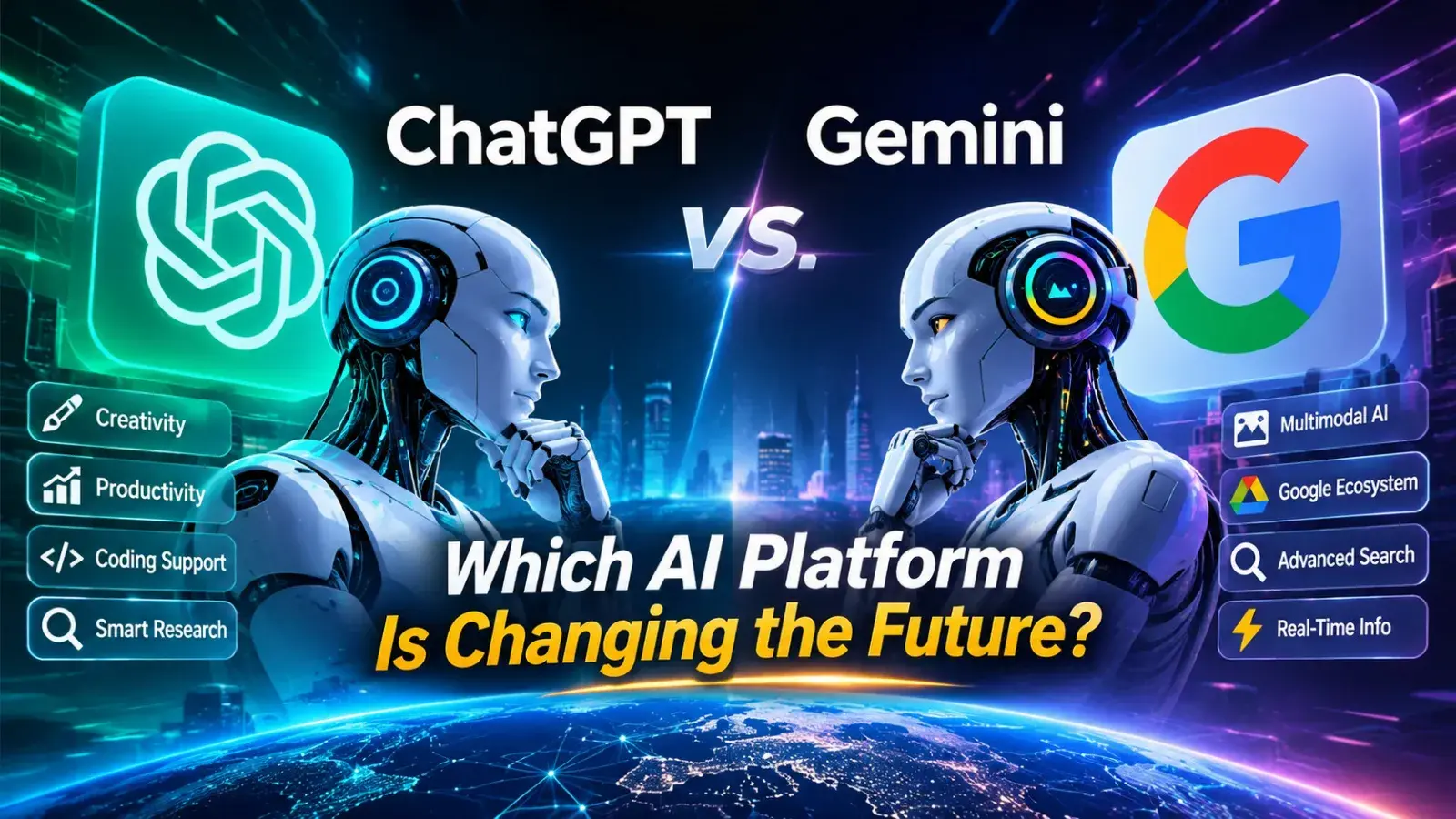
Artificial intelligence is changing how people work, communicate, learn, and make business decisions. Among the most influential AI platforms, ChatGPT by OpenAI and Gemini by Google have become major competitors. Both platforms are moving beyond simple question-and-answer interactions, offering advanced capabilities for research, content creation, productivity, coding, and business automation.
But which platform is changing the future more significantly? The answer depends on how people use AI, what problems they want to solve, and how effectively these technologies fit into their daily workflows.
Rather than declaring one platform the winner, it is important to understand their strengths, differences, limitations, and potential impact on the future of digital technology.
1. ChatGPT and Gemini: Understanding the Difference
ChatGPT and Gemini are advanced AI assistants designed to understand natural language and help users complete different tasks.
ChatGPT, developed by OpenAI, is widely used for writing, brainstorming, research, programming assistance, problem-solving, and working through complex instructions. Its broader ecosystem of tools also supports creative and professional workflows.
Gemini, developed by Google, focuses on multimodal intelligence and integration with Google's ecosystem. It can work with text, images, audio, and other types of information, depending on the model and available features. Its connections with Google services can also make it useful for people who already rely on Google's productivity tools.
Although both platforms share similar goals, their features, integrations, and user experiences are not identical. The best choice depends on the task rather than brand popularity.
2. Content Creation and Everyday Productivity
One of the biggest reasons people use AI assistants is to save time on everyday tasks.
ChatGPT can help users develop article outlines, rewrite business communications, generate marketing ideas, summarize information, and improve written content. It can also assist with brainstorming and organizing complex projects into manageable steps.
Gemini offers similar capabilities, helping users generate content, summarize information, explore ideas, and work with different forms of input. Its integration with Google's ecosystem can be particularly useful for users who manage documents, emails, and other work through Google services.
For businesses, the real advantage is not simply generating content faster. It is improving the entire process, from research and planning to editing and delivery.
However, AI-generated content still requires human review. Accuracy, originality, tone, and relevance should always be checked before publishing or sharing important material.
3. AI-Powered Research and Information Analysis
Research is another area where both platforms offer valuable capabilities.
ChatGPT can help break complicated subjects into understandable explanations, compare different approaches, organize research findings, and support structured analysis. When web search is available, it can also help users explore current information and examine supporting sources.
Gemini can assist with research, information summaries, and analysis across different content formats. Its connection with Google's services may also support workflows involving information stored across compatible applications.
However, users should not assume that every AI-generated answer is accurate. Both systems can misunderstand questions, overlook important context, or produce information that requires verification.
For professional research, users should compare important claims with reliable sources instead of depending entirely on AI-generated responses.
4. Coding and Software Development
AI is also transforming the software development process. Developers increasingly use AI assistants to understand code, identify errors, generate examples, explain programming concepts, and accelerate repetitive development tasks.
ChatGPT can support programming discussions, debugging, code explanations, and software architecture planning. Gemini can also assist with coding, reasoning, and understanding large amounts of contextual information, depending on the available model.
Neither platform should be treated as a replacement for professional software engineering. Generated code needs testing, security reviews, performance evaluation, and human judgment.
Businesses developing digital products can also benefit from combining AI capabilities with professional engineering expertise. For example, AI-powered software development solutions can help organizations explore ways to improve applications, automate processes, and build technology around real operational requirements.
The future of development will likely involve collaboration between experienced developers and increasingly capable AI tools.
5. Business Automation: Where AI Becomes More Powerful
The impact of AI goes beyond writing and answering questions. Businesses are increasingly exploring how intelligent systems can support repetitive tasks and connect different stages of their operations.
Examples include:
Automating customer support workflows.
Organizing and summarizing business information.
Supporting sales and lead qualification.
Generating reports from structured data.
Assisting with internal knowledge management.
Connecting applications through automated workflows.
ChatGPT and Gemini can support different parts of these processes, depending on their available integrations and tools.
More advanced implementations can involve AI agents that interact with business systems, retrieve information, and perform multi-step tasks within defined permissions.
Companies exploring AI development and automation can investigate how these technologies fit into existing applications and workflows.
However, successful automation requires more than connecting an AI model to a business application. Organizations need reliable data, clear permissions, monitoring, security controls, and human approval for sensitive decisions.
6. Security, Privacy, and Responsible AI Use
As AI platforms become more integrated into professional environments, data protection becomes increasingly important.
Users may share business documents, customer information, internal communications, or other sensitive material with AI tools. Before doing so, they should understand the platform's privacy settings, data policies, organizational controls, and available security options.
Businesses should establish clear guidelines covering:
What information employees can share with AI tools.
Which applications and systems AI can access.
Who is authorized to approve automated actions.
How AI-generated outputs are reviewed.
How sensitive information is protected.
AI agents require additional attention because they may interact with external tools and perform actions rather than simply generate responses.
Organizations considering AI agent development should prioritize permission management, activity monitoring, testing, and human oversight from the beginning.
Responsible AI adoption is essential for building long-term trust.
7. ChatGPT vs. Gemini: Which Platform Should You Choose?
There is no universal winner because both platforms serve different needs.
ChatGPT may be a strong choice for users who prioritize structured writing, conversational problem-solving, coding assistance, and a broad range of productivity workflows.
Gemini may be attractive to users who value multimodal capabilities and integration with Google's ecosystem.
Before choosing either platform, consider these factors:
Your daily tasks: Identify whether you primarily need writing, research, coding, data analysis, or automation.
Available integrations: Check whether the platform works effectively with the applications and services you already use.
Accuracy and reliability: Test both tools using real tasks and verify their results.
Privacy requirements: Review data handling policies and available organizational controls.
Cost and accessibility: Compare free and paid plans, usage limits, and feature availability in your region.
Testing both platforms against the same practical tasks is often more useful than relying on general comparisons.
8. What Does the Future of AI Look Like?
The competition between ChatGPT and Gemini represents a much larger transformation in the technology industry.
AI is gradually moving from standalone assistants toward systems that can understand context, work across multiple formats, connect with applications, and support complex workflows.
Future developments may make AI more useful in software engineering, healthcare administration, education, customer experience, digital marketing, and business operations. However, progress will also bring challenges involving privacy, security, accountability, and the quality of automated decisions.
Businesses that prepare for these changes by investing in secure infrastructure, employee skills, and practical AI integration will be better positioned to benefit from new opportunities.
The goal should not be to adopt every new AI feature. It should be to identify where intelligent technology can solve genuine problems and deliver measurable value.
Final Thoughts
ChatGPT and Gemini are both influencing the future of artificial intelligence, but their competition is about more than which assistant produces better answers. It reflects a broader shift toward intelligent, connected, and increasingly automated digital experiences.
For individuals, the right platform is the one that improves productivity and supports their everyday needs. For businesses, the bigger opportunity lies in combining AI capabilities with reliable software, secure systems, and well-designed workflows.
Ultimately, the future will not be shaped by AI platforms alone. It will be shaped by how intelligently people and organizations use them.


Join the conversation
Discussion0
Join the conversation. Sign in to leave a response or reply to comments.