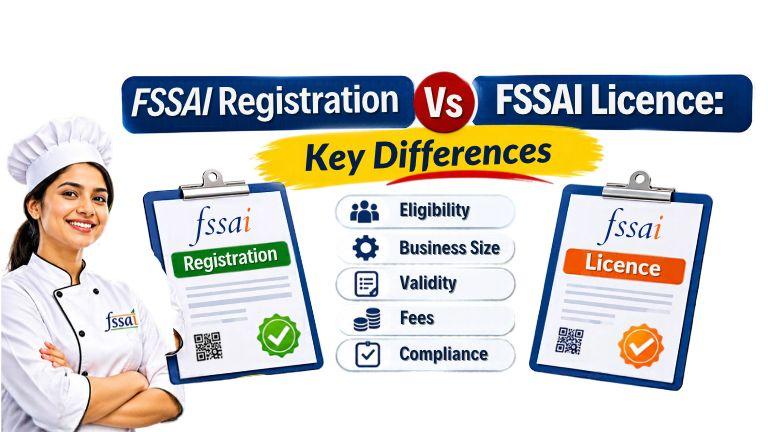
In India, it is necessary for every food business to acquire the required food safety license depending upon its field of operations. The type of license varies according to the type of operations and turnover of the business be it FSSIA registration, the state license, or the central license. Choosing the wrong type of license can lead to trouble with compliance. It should always be checked beforehand.
New rules introduced in 2026 modified the turnover limits and gave a perpetual validity with a fixed fee and compliance obligations.
Legal Framework Governing FSSAI Approval
The requirement for obtaining the license before starting the food business is given in Section 31 of the Food Safety and Standards Act, 2006. There are exemptions given for petty manufacturers, hawkers, retailers and others.
The Food Safety and Standards (Licensing and Registration of Food Businesses) Regulations in 2011 contain the licensing and registration framework. The process of application is handled by FoSCoS.
What Is FSSAI Registration?
FSSAI registration forms the required one for small food businesses eligible under the act. It typically covers petty retailers, food stall owners, hawkers, and small manufacture’s unit. A home-based business, tea stall, and street vendor comes under it.
Before 2026, the registration was generally applicable to the businesses having an annual turnover of not more than ₹12 lakh. However, as per the order from FSSAI on 13 March 2026, the threshold for registration was changed to ₹1.5 crore.
What Is an FSSAI Licence?
Businesses outside the basic registration category require a State or Central licence, depending on turnover and activity. Under the revised general limits, a State licence applies to turnover above ₹1.5 crore and up to ₹50 crore. A Central licence generally applies above ₹50 crore.
Certain activities require a Central licence irrespective of turnover. These include food importers, e commerce food businesses and merchant exporters, among other categories listed in FoSCoS. A food importer earning ₹50 lakh may still need a Central licence.
FSSAI Registration vs Licence: Key Differences
1. Eligibility and Turnover
The new categorization comes into effect on April 1, 2026 with the following divisions:
Basic registration: annual turnover of up to ₹1.5 crore;
State licence: from ₹1.5 crore to ₹50 crore;
Central licence: required for ₹50 crore.
These are set to replace the previous threshold of ₹12 lakh and the ₹20 crore limit for State-level registration. However, it should be noted that turnover level is important only for those whose business is import, either the businesses operating in the e-commerce area or the ones specializing in certain kinds of food products. Before selecting a category, please ensure that you check the Feasibility of Operations of Food Safety Compliance (FoSCoS) classification.
2. Application Process and Documents
Both the applications mentioned are submitted electronically on FoSCoS. Basic registration generally includes providing a photograph and identification issued by the government, the office location, and food business information.
State and Central applications require possible integration or partnership documents, proof of location, a layout diagram, machinery details, information about the director/member of management, as well as a plan and technical evidence regarding the Food Safety Management System.
The requirements vary for each activity. Use necessary FoSCoS checklist.
3. Government Fees
Basic registration generally costs ₹100 per year. State licence fees depend on the business category and are commonly ₹5,000 annually for several major activities. A Central licence generally costs ₹7,500 per year, subject to exceptions. Check the FoSCoS eligibility matrix before payment.
4. Validity and Annual Payments
The Licensing and Registration Regulations are amended in 2026 to include permanent validity for certificates and licenses. Instead of choosing a validity period and applying for a renewal, the operator’s certificate remains valid, unless canceled, suspended, or surrendered.
Permanent validity does not take away the obligation of operators to pay for licensing. The license fee is payable by the operator. Failure to pay the fee or submit the appropriate food safety return on time will result in the automatic suspension of the activities.
5. Compliance and Inspection
It is understood that there is a requirement for businesses to adhere to hygiene and sanitation expectations as per Schedule 4 of the Regulations for licensed and registered businesses. Licensed businesses may have additional compliance expectations, depending on the nature of the business including production record-keeping, storage methods, and technical requirements.
The reforms of 2026 introduced a shift towards risk-based inspections. Frequency may vary as a function of business type, compliance record, and food risks. There was an amendment published on 23 June 2026 that has updated some requirements for records and stock rotation practices. Producers have a requirement to keep separate daily records of production and raw materials. Non-manufacturing entities are not subject to the former condition, while the FIFO and FEFO practices are not applicable for retailers.
Consequences of Operating Without Required Approval
Operating without the necessary authorization mandated by the Act can lead to compliance actions. Section 63 of the Food Safety and Standards Act pertains to conducting a food operation without a license. Following the Jan Vishwas (Amendment of Provisions) Act, 2023, the fine could go up to ₹10 lakh.
The provision applies to businesses that are required to possess a license for making, selling, storing, distributing, or importing food but are doing so without it. Section 31(2) provides exemptions to certain individuals but they have to apply for registration, where applicable.
Any business violating the licensing requirement must obtain the necessary approval.
Changes Existing Businesses Should Know
The alterations in turnover limits do not compel current operators to submit new applications. As per the FSSAI FAQs issued on March 27, 2026, the transition into the new class will be automatically undertaken by FoSCoS based on the self-declaration of the operator.
There will be no need to pay any migration charges or receive a new registration number, as the current registration number will apply. This will be the case even if a business qualifies for registration based on its State licence, as any charges already incurred for that will be adjusted against the yearly registration costs.
According to the Street Vendors (Protection of Livelihood and Regulation of Street Vending) Act, 2014, street food vendors registered under that Act will also register under the Food Safety and Standard Act and adhere to sanitary conditions.
Conclusion
FSSAI approval depends on turnover, activity and eligibility. Registration generally covers smaller businesses; State and Central licences cover larger or specified operations.
The 2026 reforms raised thresholds and introduced perpetual validity, but annual fees, returns and safety duties remain. Check the FoSCoS category and maintain required standards to avoid costs, delays and enforcement.
Frequently Asked Questions
1. What is the turnover limit for FSSAI registration in 2026?
The general threshold for basic registration is annual turnover up to ₹1.5 crore for applications from 1 April 2026. Businesses above it generally require a State or Central licence, depending on turnover and activity.
2. Is FSSAI registration the same as an FSSAI licence?
No. Registration is the basic approval for eligible petty food businesses. A State or Central licence is required for businesses falling within the respective licensing categories under the Act.
3. Does an FSSAI licence need annual renewal?
No. Under the 2026 amendment, registrations and licences have perpetual validity unless suspended, cancelled or surrendered. Annual fees and other compliance requirements still apply.
4. Can a food importer operate with basic registration?
No. Food importers require a Central FSSAI licence under the importer category, irrespective of annual turnover.
5. What is the penalty for operating without the required FSSAI licence?
Section 63 provides for a penalty that may extend to ₹10 lakh for an operator required to hold a licence but carrying on the food business without it.
Join the conversation
Discussion0
Join the conversation. Sign in to leave a response or reply to comments.