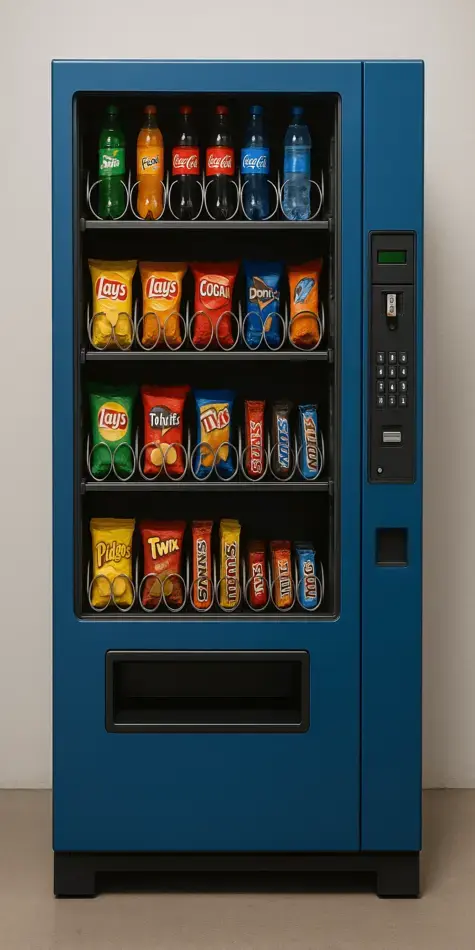
A vending machine in the break room used to be set-and-forget. Fill it once a week, collect the cash, hope nothing jams. That model's quietly disappearing. The machines we build for clients now are connected devices — they report inventory in real time, take contactless payments, and tell someone in ops exactly what to restock before it runs out.
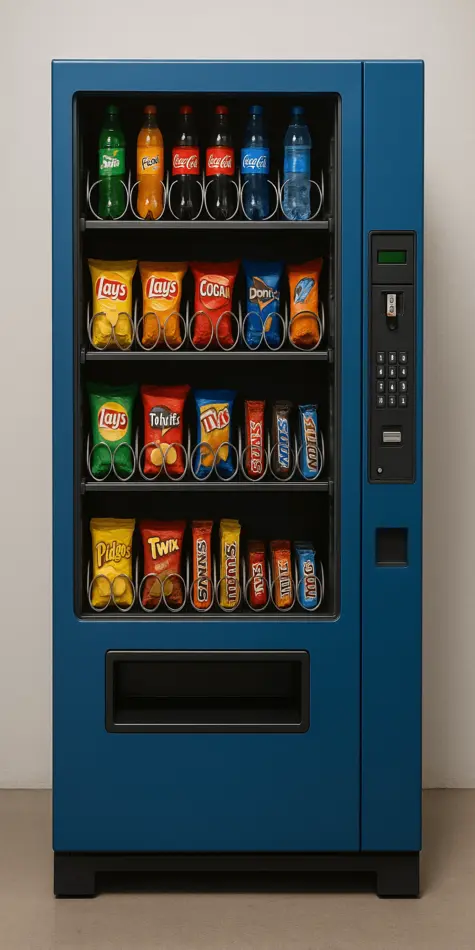
We've designed and shipped the electronics and firmware behind several of these systems. Here's what actually changes on the operations side when a vending machine gets a network connection and a proper control board.
What "connected" actually means at the hardware level
A connected vending machine is a machine with a controller that talks to the internet. In most of the builds we do, that's an ESP32 module handling Wi-Fi and BLE, or an nRF52 when the design leans on BLE provisioning and low power. The controller sits between the existing vending mechanism and the outside world. It reads the coin and bill acceptor, drives the motor selection board, and manages the payment terminal over serial or USB.
Firmware runs on something like Zephyr RTOS when we need a real-time scheduler and a clean driver model across multiple peripherals. For simpler builds, a bare-metal loop on the ESP32 is fine. The controller publishes telemetry over MQTT to a broker — typically every few minutes, or immediately on a sale event. That message carries the machine ID, item slot, timestamp, payment method, and fault flags.
The PCB itself matters more than people expect. Vending machines are electrically noisy — motors, compressors, fluorescent ballasts. We usually design a four-layer board in KiCad with proper isolation between the motor drive side and the logic side, plus TVS protection on every external line. Skip that step and you get a controller that resets every time the compressor kicks on.
Inventory visibility without the guesswork
The single biggest operational win is knowing what's in the machine without sending someone to look. Each selection motor has a position sensor, or the controller tracks dispense events against a calibrated slot map. When stock for a slot hits a threshold, the system fires a restock alert with the exact SKU and quantity.
For a company running 40 machines across office campuses, that changes route planning completely. Instead of a fixed weekly visit to every site, the ops team gets a pick list generated from live data. Drivers visit the machines that actually need filling. One client we worked with cut restock trips by roughly a third within two months — not because the machines sold less, but because nobody was driving to sites to top off two rows.
An office vending machine that reports its own stock also stops the worst failure mode: the machine that's empty on Monday morning because everyone hit it Friday afternoon. The alert goes out Friday, someone restocks before the weekend, and Monday starts clean.
Payments and reconciliation
Cash handling is a cost center. Counting, transporting, and reconciling cash across dozens of machines eats hours every week and invites shrinkage. Connected machines move to card, UPI, and mobile wallet payments, and every transaction lands in a dashboard with a timestamp.
Reconciliation work drops to near zero. Finance pulls a report instead of counting tills. Refunds and disputes get resolved from transaction logs rather than memory. For a smart vending machine for office deployments, contactless payment is also just what people expect now — nobody carries coins, and a machine that only takes cash loses sales quietly.
Predictive maintenance and fault reporting
Motors fail. Bill acceptors jam. Temperature-controlled machines drift out of range. A connected controller catches these as events, not complaints.
We route fault codes through the same MQTT pipeline. A jammed motor reports its slot number and error state. A temperature sensor on a refrigerated unit flags when the compressor runs longer than its normal duty cycle — an early sign of failure before product spoils. The maintenance team gets a ticket with the machine ID and the specific fault, so the technician arrives with the right part instead of diagnosing on site.
This is where the firmware design pays off. We log faults to non-volatile memory so a power cycle doesn't erase the evidence. The device also sends a heartbeat; if a machine goes silent for more than a set window, that's its own alert. A dead machine nobody notices is worse than one that reports a problem.
Remote configuration and firmware updates
Fleet management means pushing changes without a site visit. Pricing updates, new product mappings, payment terminal configs — all of it goes out over the air. We build OTA update paths with A/B partitions so a failed update rolls back instead of bricking the unit. For fleets in the hundreds, that reliability is the difference between a manageable rollout and a support nightmare.
Provisioning new machines gets simpler too. BLE setup from a phone app lets a technician commission a unit on site — network credentials, machine ID, slot map — in a few minutes, without opening a laptop.
What this means for daily operations
The shift is from reactive to scheduled. Inventory, payments, faults, and updates all run on data instead of routine. The break room machine stops being a background annoyance and becomes a managed asset with a dashboard.
If you're building a connected vending system or retrofitting an existing fleet, the hardware and firmware choices you make early — the controller, the isolation on the board, the telemetry protocol — determine how well it scales. We work on exactly this kind of build, from PCB design through firmware and prototype shipping. Happy to talk through the architecture if you're planning one.

Join the conversation
Discussion0
Join the conversation. Sign in to leave a response or reply to comments.