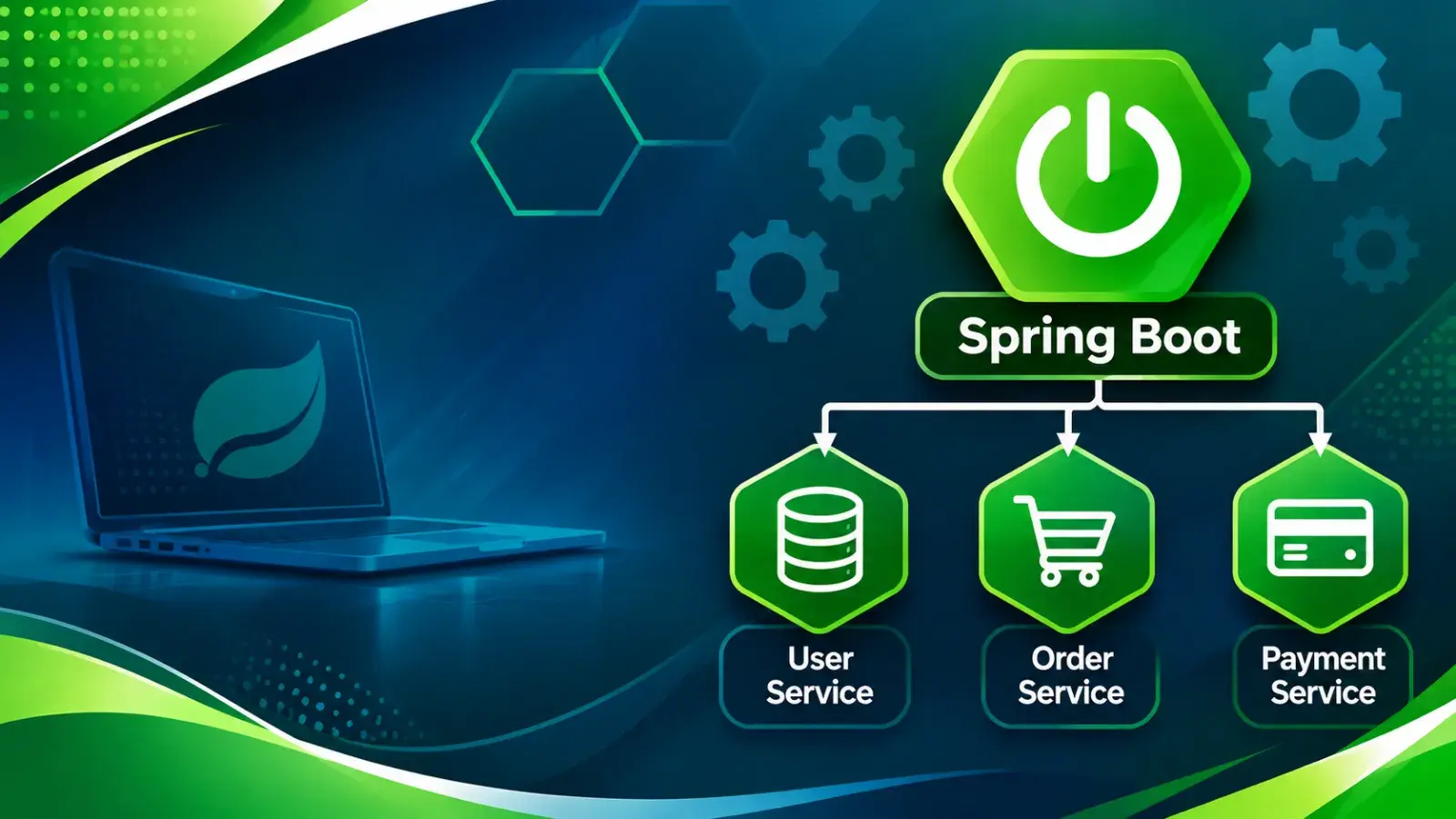
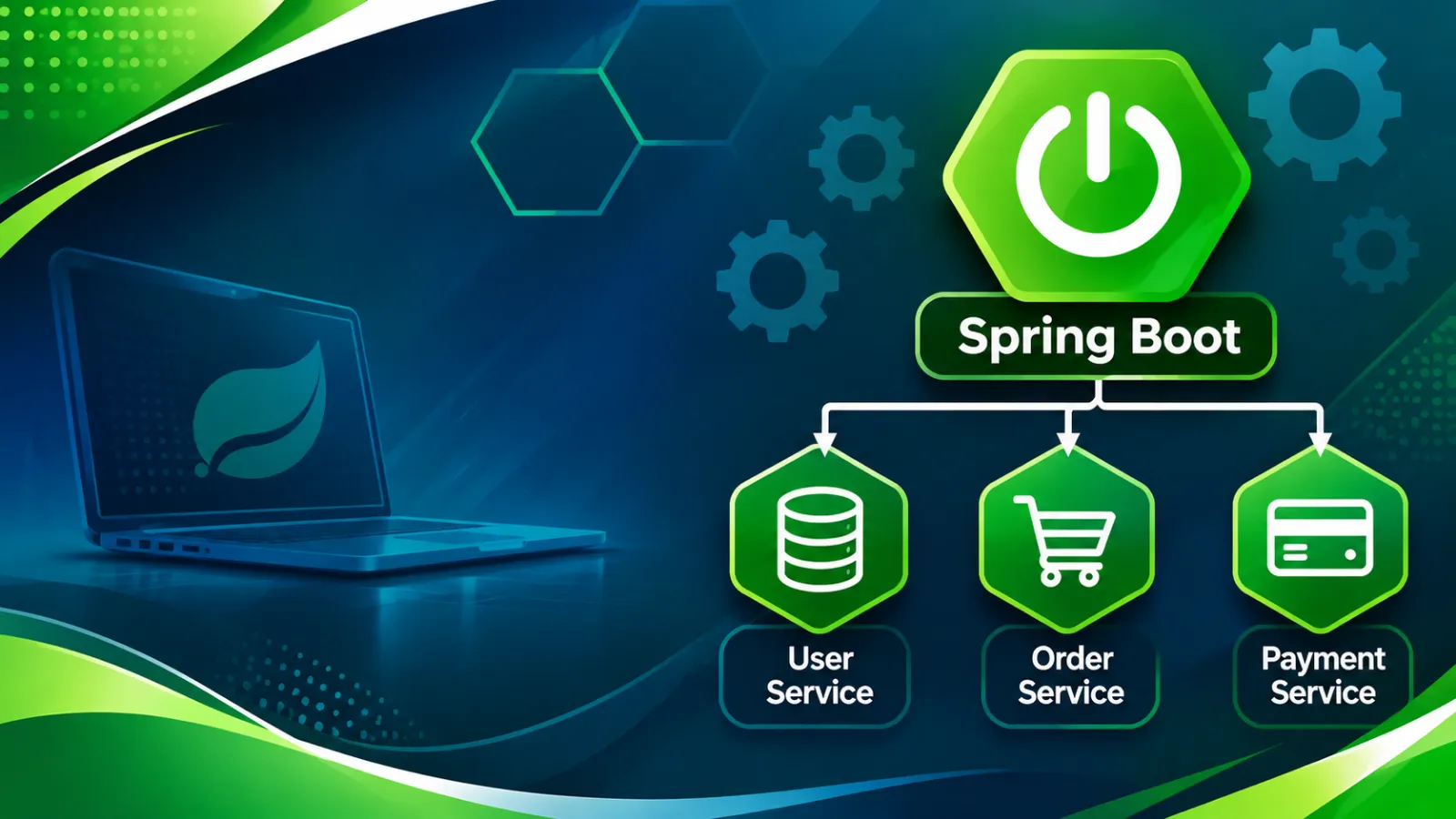
As businesses grow, their software needs to handle more users, larger amounts of data and increasingly complex operations. An application that works perfectly for a small customer base may eventually struggle when new features, integrations and workloads are introduced. This is where microservices architecture can make a meaningful difference.
Instead of developing an entire application as one large system, microservices divide it into smaller, independent services. Each service handles a specific business responsibility and can be developed, tested, deployed and maintained separately.
Spring Boot has become a popular choice for building these applications because it simplifies Java development, reduces configuration overhead and provides tools for creating production-ready services. Combined with Spring Cloud, it also supports common distributed-system requirements such as service discovery, centralised configuration and fault tolerance.
But how do you actually build microservices using Spring Boot? More importantly, how do you make sure they remain manageable as your application grows?
Let's explore the process, from planning your architecture to deploying your first services.
What Are Microservices and Why Does Spring Boot Matter?
Microservices architecture is a software development approach in which an application consists of multiple independently deployable services. Each service focuses on a particular business capability and communicates with other services through well-defined interfaces.
For example, an e-commerce platform might contain:
User Service: Manages customer accounts and authentication.
Product Service: Handles product information, categories and inventory.
Order Service: Processes customer orders.
Payment Service: Manages payment requests and transaction statuses.
Notification Service: Sends order confirmations and customer updates.
Rather than placing all these responsibilities inside one application, each can operate as a separate service.
Spring Boot makes this approach easier by providing automatic configuration, starter dependencies, embedded servers and straightforward application packaging. Developers can build individual services without spending unnecessary time configuring the underlying framework.
The Spring ecosystem also provides additional tools for handling the challenges associated with distributed applications.
Why Choose Spring Boot for Microservices Development?
Choosing the right framework can influence how easily a software system evolves. Spring Boot offers several advantages that make it suitable for microservice-based applications.
1. Faster Application Development
Spring Boot provides starter dependencies that simplify project configuration. Instead of manually selecting and configuring numerous libraries, developers can add the functionality their services require.
For example, Spring Web makes it straightforward to create REST APIs, while Spring Data JPA simplifies database access.
2. Independent Deployment
Each microservice can be packaged and deployed independently. This means developers can update the payment service without necessarily redeploying the entire e-commerce platform.
Independent deployment also allows teams to work on different business capabilities without constantly interfering with one another.
3. Flexible Technology Choices
Although Spring Boot services commonly use Java, different services can communicate through standard APIs or messaging systems. This creates opportunities to integrate services developed using different technologies when business requirements justify it.
4. Better Scalability
Not every component of an application experiences the same workload. For example, a product catalogue might receive significantly more requests than an internal reporting service.
With independently deployable services, teams can allocate additional resources to the components that need them instead of scaling the entire application unnecessarily.
5. A Strong Ecosystem
Spring Boot works alongside Spring Cloud, Spring Security, Spring Data and other projects. These tools help developers address authentication, distributed configuration, service communication and operational monitoring.
However, the framework alone does not guarantee scalability. Good architecture, sensible infrastructure choices and proper testing remain essential.
Step 1: Plan Your Microservices Architecture
Before writing code, identify the business responsibilities your application needs to support.
One common mistake is dividing an existing application into services based purely on technical components. For instance, creating separate services for every database table can introduce unnecessary communication and maintenance overhead.
A structured development approach is equally important when planning a microservices architecture. Before selecting technologies or dividing an application into independent services, development teams should establish clear requirements, define project objectives and understand how different components will work together. Following a well-organised software development process can help teams manage these stages more effectively, reduce unnecessary complexity and build applications that are easier to maintain as business requirements evolve.
Instead, organise services around business capabilities.
Consider an online shopping application. A practical starting architecture could look like this:
API Gateway
|
-------------------------
| | |
Product Order User
Service Service Service
| |
Product Order
Database Database
|
Payment Service
|
Payment Database
Each service should have a clearly defined responsibility, its own deployment lifecycle and appropriate ownership of its data.
It is also important to decide how services will communicate, how failures will be handled and which components need to share information.
A well-planned architecture prevents small development decisions from becoming expensive problems later.
Step 2: Create Your First Spring Boot Microservice
The easiest way to start is through Spring Initializr.
Create a new project and select:
Project: Maven
Language: Java
Framework: Spring Boot
Dependency: Spring Web
Java: 17 or a supported newer version
Generate the project and open it in your preferred development environment, such as IntelliJ IDEA or Eclipse.
For this example, let's create a simple Product Service that provides product information through a REST API.
Create the Main Application Class
package com.example.productservice;
import org.springframework.boot.SpringApplication;
import org.springframework.boot.autoconfigure.SpringBootApplication;
@SpringBootApplication
public class ProductServiceApplication {
public static void main(String[] args) {
ProductServiceApplication.class, args
);
}
}
The @SpringBootApplication annotation enables Spring Boot's application configuration and component scanning.
Create a Product Model
package com.example.productservice;
public record Product(
Long id,
String name,
double price
) {}
This record represents a basic product with an ID, name and price.
Create a REST Controller
package com.example.productservice;
import org.springframework.web.bind.annotation.*;
import java.util.List;
@RestController
@RequestMapping("/api/products")
public class ProductController {
@GetMapping
public List<Product> getProducts() {
return List.of(
new Product(1L, "Laptop", 899.99),
new Product(2L, "Smartphone", 599.99),
new Product(3L, "Headphones", 89.99)
);
}
}
The @RestController annotation allows the application to expose REST endpoints.
Once the application is running, you can access:
http://localhost:8080/api/products
The endpoint returns a JSON response containing the available products.
This is a simple example, but it demonstrates the foundation of a Spring Boot microservice: a standalone application with a clearly defined responsibility and an accessible API.
For a production application, you would also introduce a service layer, persistent storage, validation, exception handling and appropriate security controls.
Step 3: Build a Second Microservice
Now that the Product Service is running, the next step is to create another independent application.
Let's introduce an Order Service.
The Order Service should handle order-related operations rather than managing product information itself.
For example, when a customer places an order, the Order Service can request product information from the Product Service before processing the order.
A separate Spring Boot project should be created for this purpose, with its own application class, dependencies and configuration.
You can run the services on different ports:
Product Service: 8080
Order Service: 8081
Configure the Order Service to communicate with the Product Service through its REST API.
This separation makes it possible to develop and deploy each application independently while keeping their responsibilities clear.
Step 4: Enable Communication between Microservices
Microservices need a reliable way to exchange information.
There are two common communication approaches.
Synchronous Communication
In synchronous communication, one service sends a request to another and waits for a response.
REST APIs are widely used for this purpose. Spring applications can use HTTP clients such as RestClient or WebClient, depending on their requirements.
For example, an Order Service can request product details before accepting an order.
The advantage is simplicity. However, if the Product Service becomes unavailable or responds slowly, the Order Service may also experience delays.
Timeouts and sensible error handling are therefore important.
Asynchronous Communication
Asynchronous communication allows services to exchange messages without requiring the receiving service to respond immediately.
Technologies such as Apache Kafka and RabbitMQ can support this approach.
For instance, after an order is successfully placed, the Order Service could publish an event. The Notification Service could then consume that event and send a confirmation email.
This reduces direct dependencies between services and can make complex workflows more flexible.
The right approach depends on the business process. Not every interaction needs a messaging platform, and not every operation should wait for a remote service.
Step 5: Use Spring Cloud for Distributed System Management
As the number of microservices increases, managing them individually becomes more complicated.
Spring Cloud provides tools that address several common distributed-system challenges.
Some useful capabilities include:
Service Discovery: Helps services locate one another without relying entirely on fixed network addresses.
Centralised Configuration: Allows application settings to be managed consistently across multiple services and environments.
API Gateway: Provides a common entry point for incoming requests, allowing routing and other cross-cutting responsibilities to be handled centrally.
Load Balancing: Distributes requests across available service instances.
Circuit Breakers: Help prevent repeated calls to an unhealthy service from causing wider failures.
These capabilities are particularly useful when an application moves beyond a small number of services.
It is important to select compatible Spring Boot and Spring Cloud versions. Their official compatibility information should always be checked before adding dependencies.
Step 6: Manage Data Independently
Database ownership is one of the most important decisions in microservices architecture.
Ideally, each service should own the data required for its business responsibilities.
For example:
Product Service manages product records.
Order Service manages customer orders.
Payment Service manages payment information.
This approach reduces direct database dependencies between services.
If multiple services freely access the same database tables, changes to one service can unexpectedly affect another. That weakens the independence that microservices are designed to provide.
However, independent databases introduce another challenge: maintaining consistency across services.
For example, placing an order and processing a payment may involve multiple operations. A failure between these operations can leave the system in an incomplete state.
Patterns such as the Saga pattern help coordinate distributed business transactions without relying on a single traditional database transaction.
Step 7: Secure Your Microservices
Security should be considered from the beginning rather than added just before deployment.
Spring Security provides a foundation for implementing authentication and authorisation.
A practical security strategy should include:
OAuth 2.0 or OpenID Connect where appropriate.
Secure service-to-service communication.
Role-based access controls.
HTTPS for external communication.
Secure storage of credentials and API keys.
Input validation and protection against common API vulnerabilities.
For applications handling sensitive customer information, it is also important to limit access to personal data and maintain appropriate audit records.
An API gateway can help centralise certain security responsibilities, but individual services should still enforce the permissions required for their own operations.
Step 8: Test, Monitor and Deploy Your Microservices
A microservice that works correctly on a developer's computer may behave differently in a production environment.
Testing should cover both individual services and their interactions.
Useful testing approaches include:
Unit Testing: Checks individual methods and business logic.
Integration Testing: Verifies that application components work correctly together.
Contract Testing: Checks whether services continue to follow their agreed API or messaging contracts.
End-to-End Testing: Tests complete business workflows across multiple services.
Spring Boot Actuator can provide health and application metrics endpoints, helping teams understand service availability and operational behaviour.
Micrometer and distributed tracing tools can also help identify performance bottlenecks and follow requests across service boundaries.
For deployment, Docker can package individual services into containers. Kubernetes or another container orchestration platform can then manage deployment, scaling and recovery where the application's requirements justify that complexity.
A sensible approach is to begin with a small deployment setup, understand its operational needs and introduce more advanced infrastructure as the system grows.
Common Mistakes to Avoid When Building Microservices
Even with the right framework, poor architectural decisions can create unnecessary complexity.
Here are some mistakes worth avoiding:
Creating too many services too early: Every service introduces additional deployment, monitoring and communication requirements. Start with meaningful business boundaries.
Sharing databases without clear ownership: This creates tight coupling and makes independent development more difficult.
Ignoring network failures: Remote calls can time out or fail. Build appropriate retry, timeout and circuit-breaker strategies.
Overlooking observability: Without centralised logs, metrics and traces, diagnosing production problems becomes difficult.
Using synchronous communication everywhere: Excessive service-to-service requests can create performance bottlenecks and dependencies.
Treating security as an afterthought: Authentication, authorisation and secure communication should be part of the initial architecture.
Skipping automated testing: Independent deployments are only useful when teams can confidently verify that changes do not break other services.
Conclusion
Building microservices using Spring Boot is about more than creating several small Java applications. It involves designing clear business boundaries, establishing reliable communication, managing data ownership and preparing services to operate independently.
Spring Boot provides a convenient foundation for building individual services, while Spring Cloud offers additional capabilities for managing distributed applications.
The best approach is to start small. Build one service, introduce another when there is a genuine business reason, and gradually add the infrastructure needed to support communication, security, monitoring and deployment.
For businesses planning complex digital products, the same architectural thinking applies to broader software decisions: understand the requirements, choose the right technology and build a foundation that can evolve. Exploring professional custom software development resources can help teams understand how these decisions fit into larger product engineering projects.
Ultimately, successful microservices are not defined by how many services an application contains. They are defined by how effectively those services work together to deliver reliable, maintainable and scalable software.
Frequently Asked Questions (FAQs)
1. What is Spring Boot in microservices architecture?
Spring Boot is a Java framework that simplifies the development of standalone applications. In microservices architecture, developers use it to build independent services that expose APIs and communicate with other applications.
2. Is Spring Boot suitable for building microservices?
Yes. Spring Boot provides automatic configuration, embedded servers, REST API development and production-oriented features. It also integrates with Spring Cloud for additional distributed-system capabilities.
3. What is the difference between Spring Boot and Spring Cloud?
Spring Boot simplifies the development of individual applications, whereas Spring Cloud provides additional tools for managing distributed systems, including service discovery, centralised configuration, routing and circuit breakers.
4. How do microservices communicate with each other?
Microservices commonly communicate through REST APIs or asynchronous messaging systems such as Apache Kafka and RabbitMQ. The choice depends on the application's requirements and the level of independence needed between services.
5. Does every microservice need its own database?
Ideally, each microservice should own its data and control access through its APIs or events. This reduces direct dependencies and supports independent development, although the exact data architecture depends on the application.
6. Can Spring Boot microservices run in Docker?
Yes. Spring Boot applications can be packaged into Docker containers. These containers can run independently or be managed using platforms such as Kubernetes.
7. Is Spring Cloud necessary for every Spring Boot microservice project?
No. A small application with a few services may work perfectly well without the full Spring Cloud ecosystem. Add its components when requirements such as service discovery, centralised configuration or advanced resilience make them worthwhile.
8. What are the main challenges of microservices development?
Common challenges include distributed data consistency, network failures, service communication, security, monitoring, testing and deployment coordination. Good architecture and appropriate operational tools help manage these challenges.
Join the conversation
Discussion0
Join the conversation. Sign in to leave a response or reply to comments.