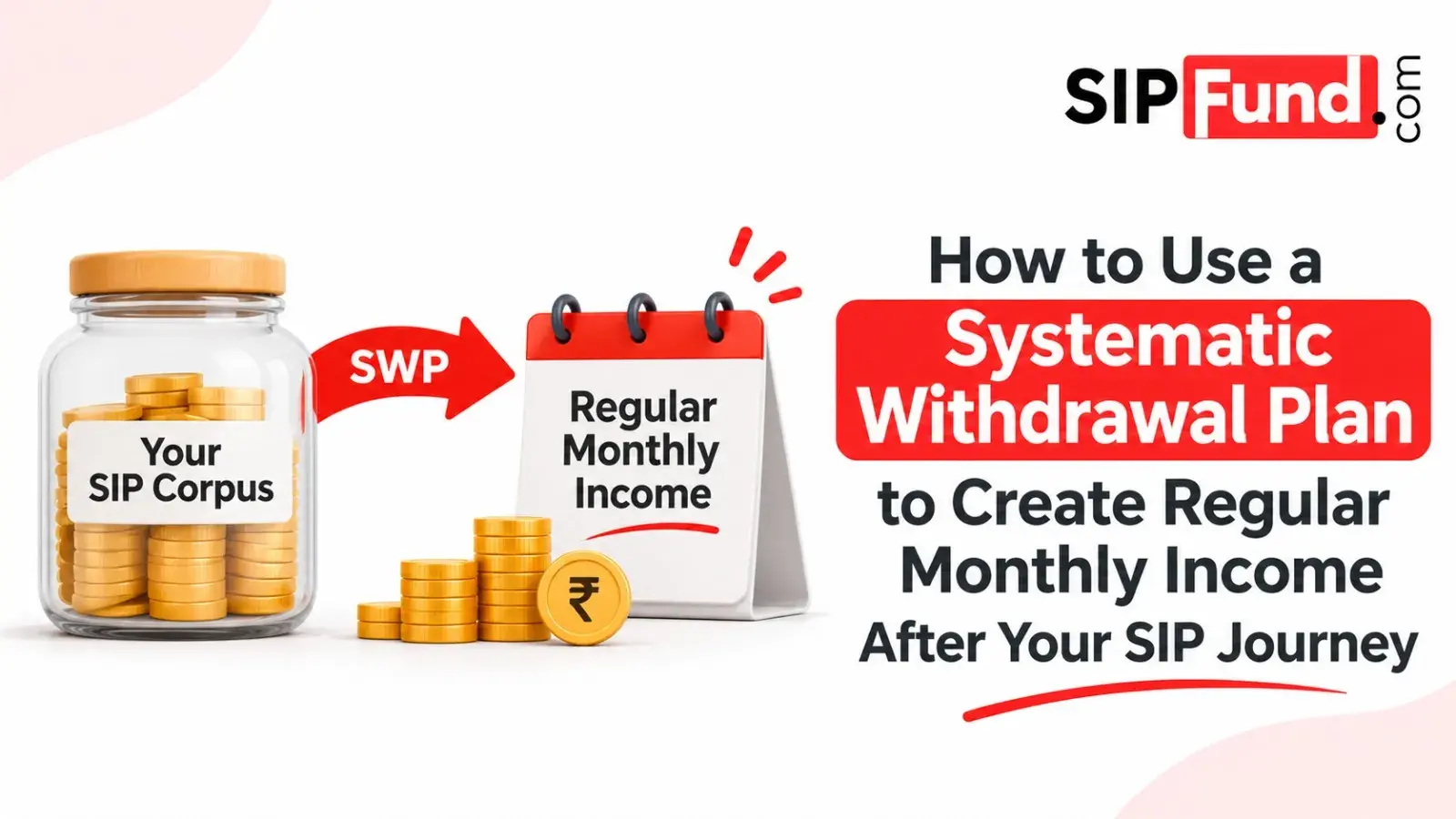
A systematic withdrawal plan lets you take a fixed amount from your mutual fund corpus every month while the rest stays invested. It is the natural next chapter after a SIP. This guide explains how it works, what SEBI changed in July 2026, the risks to respect and how to plan it.
A corpus is years of SIPs that have quietly grown into something powerful. But then a new question comes. How do you turn that stack of units into cash you can use each month, without selling everything at once or leaving it untouched on the shelf?
A systematic withdrawal plan (SWP) is the answer. It’s the opposite of a SIP. A SIP moves money from your bank to a fund every month, whereas a systematic withdrawal plan moves a fixed amount from your fund to your bank, and the remaining amount keeps working.
This guide explains what an SWP is, what SEBI changed in July 2026, how SWP withdrawals are taxed, and the risks. At SIP Fund, we believe a great plan works as well on the way out as it does on the way in.
From Building Wealth to Drawing Income
In the saving years, it’s all about investing and letting time do its job. Once the goal is reached, the task changes. You may need monthly income during retirement, money to fund a child’s education over several years, or cover for a career break. This is the kind of transition that should be planned systematically.
Selling a big block at once has two problems. It can create a large tax bill in a single year, and it can force you to sell at a bad time. Small withdrawals over many months spread out both the amount and the timing of the tax. They also keep the rest invested, so the corpus continues working for you while you withdraw.
If you’re still saving, the Knowledge Center on our blog has simple explanations of SIP basics and goal planning.
A natural next chapter after a SIP
Think of the two plans as two halves of one story. The SIP builds the corpus month by month. The SWP draws it down patiently, month by month. Both reward routine over drama, and both remove the need to time the market with one big decision. An automatic income, like the automatic investing you’re used to, is reassuring because it turns a big, daunting question into a small, manageable one.
How an SWP Creates Monthly Income
An SWP is easy to set up. You choose three things: the fund, the amount and the date. Each month, on that date, the fund house redeems enough units to pay you the amount and deposits it into your bank account. Depending on the fund house, you can choose a fixed amount or a fixed number of units, and a monthly or quarterly frequency.
Whatever stays in the fund remains invested. If the corpus earns more than you withdraw, it can keep growing. If it earns less, the corpus slowly shrinks. At its heart, every systematic withdrawal plan is that simple balance between what you take out and what the fund earns.
An SWP also gives you flexibility that a fixed deposit does not. Usually, you can increase, decrease, pause or stop the withdrawals, depending on the fund house’s rules, and you can choose the monthly income you actually need. It suits a lump sum or a corpus you have already built, which is exactly what years of SIPs create. The plan can adapt to your expenses, and that flexibility is one of its hidden benefits.
What SEBI Changed for SWP in July 2026
In its circular dated 17 July 2026, SEBI extended the facility of setting up standing instructions for SWPs and Systematic Transfer Plans to mutual fund units held in demat form. The circular notes that investors can already set up an SWP by giving standing instructions to the fund house or its registrar for periodic redemption of a specified number of units or amount.
Why does this matter? Many investors keep units in their demat account for convenience, and until now it was harder to automate withdrawals from them. The change removes a practical obstacle: how you hold your units no longer decides whether you can have an automatic income.
Outlook Money reported that the rollout will happen in two stages, with the first allowing unit-based mandates, where a fixed number of units is redeemed at a set frequency.
Unit-based means the number of units is fixed and your rupee payout depends on the unit price. It is to be followed by amount-based mandates, which are expected to fix the rupee payout. Before you budget around it, find out which type your fund house or depository offers. It’s a small detail that makes a big difference to budgeting: a fixed number of units gives a payout that moves with the market, while a fixed rupee payout is easier to plan around. Both are valid, but know which one you have.
ETV Bharat reported that, until now, investors could create such standing instructions only for units held in statement of account form, and that SEBI’s move aims at ease of doing business.
The circular doesn’t require you to do anything if your units aren’t in demat form. Your existing SWP stays unchanged. The bottom line: you now have more options for regular withdrawals, and no new rules to worry about. Do read your fund house’s instructions, as the steps may vary between fund houses and depositories.
How SWP Withdrawals Are Taxed
Every SWP payment is a redemption of units and is taxed as one. Only the gain portion of each payment is taxed, not the whole payment, because part of each payment is your own capital coming back. The tax rate depends on the type of fund and how long the units were held. So the same monthly payment may carry a different tax in the first month than in the tenth.
Outlook Money’s tax reckoner for FY 2026-27 states that equity mutual funds are taxed at 12.5% on long-term capital gains above ₹1.25 lakh, while non-equity and specified schemes are taxed at slab rates. For an equity fund SWP, that means the yearly exemption can cover part of your gains, which is one reason many retirees consider it. You can also compare it with IDCW payouts in our guide on IDCW vs SWP for regular income.
Units are typically redeemed oldest first, so some early withdrawals may come from units that are still short-term and taxed at a higher rate. Before you begin, consult a tax professional about your own situation.
The Risks: Why Your Corpus Needs Care
An SWP does not protect the corpus from market declines. The fund’s value can fall while your withdrawal amount stays the same. If markets dip early in the plan, you sell more units at lower prices to get the same amount, and the corpus can shrink faster than expected. This is known as sequence of returns risk, and it is the most important idea in this guide.
The second risk is withdrawing too much. When you take out more than the fund earns, you’re using up your capital. A modest withdrawal rate gives the corpus a chance to last. For instance, if the corpus is ₹50 lakh and the monthly withdrawal is ₹25,000, the yearly withdrawal is ₹3 lakh, which is 6% of the corpus. Ask for advice, because that may not be sustainable for your fund or time frame.
The third risk is inflation. A fixed payout loses buying power over the years. Many plans raise the withdrawal slightly every year, much like a step-up SIP raises the investment, but the bigger the withdrawal, the more it eats into the corpus. The simplest fix is to review the withdrawal once a year, not once every ten.
How to Plan Retirement Income With a Systematic Withdrawal Plan
Keep some money in steadier funds
Keep the next one or two years of expected withdrawals in a debt or liquid fund. Then you don’t have to sell equity units to pay your bills when the market crashes. This is a simple way to protect your retirement income.
Start with a modest amount
Start with a withdrawal you could sustain through a long stretch of poor returns. You can increase it later once the corpus has grown. A lower payout in the early years works like insurance against a bad start. It costs little and can save a lot.
Review once a year
Review the corpus, withdrawals and needs every year. Make gradual adjustments instead of reacting to a single bad month. Write down your decision and your reasoning, so you don’t rewrite the plan in a nervous moment.
Take advice for your situation
Taxes, health and family costs vary. A good advisor can build a plan around your situation and help you decide how much of your money to place in each type of fund.
Bottom Line: Finish the Journey as Well as You Started It
A systematic withdrawal plan is an effective way to turn years of patient SIPs into regular monthly income, without selling everything at once. It isn’t guaranteed, and it needs a sensible withdrawal strategy. Used wisely, it keeps your savings working for you, and the same habits that grew your savings help keep them safe.
Give SIP Fund a call at +91 9513355661 or email info@sipfund.com and let our team guide you on your investments and plan your SIP journey, from the first investment to the first withdrawal.
Disclaimer: This is information and education only and not investment advice. Past performance does not guarantee future results. Mutual fund investments are subject to market risks. Before investing, please read all scheme related documents carefully and seek advice from a registered advisor.




Join the conversation
Discussion0
Join the conversation. Sign in to leave a response or reply to comments.