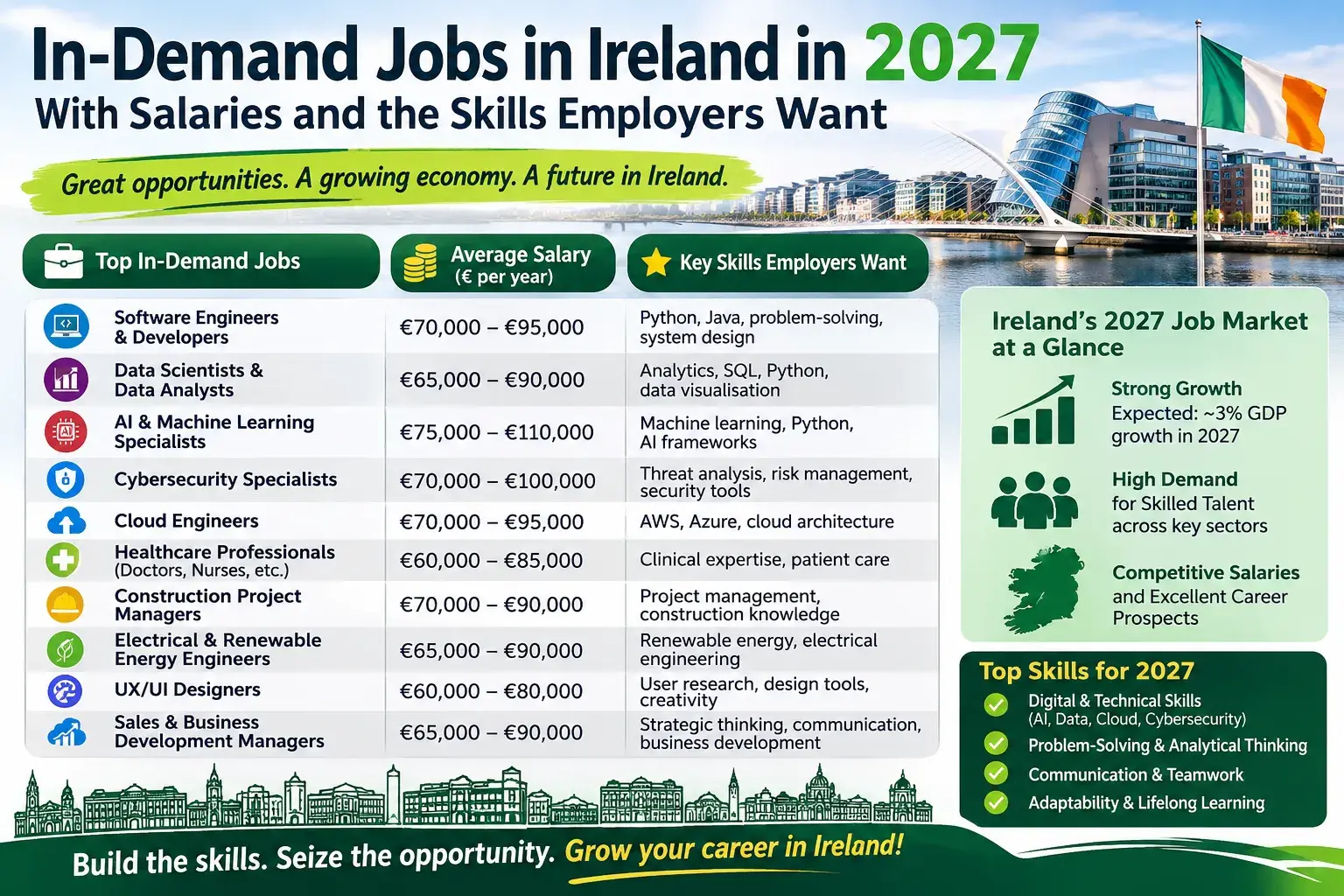
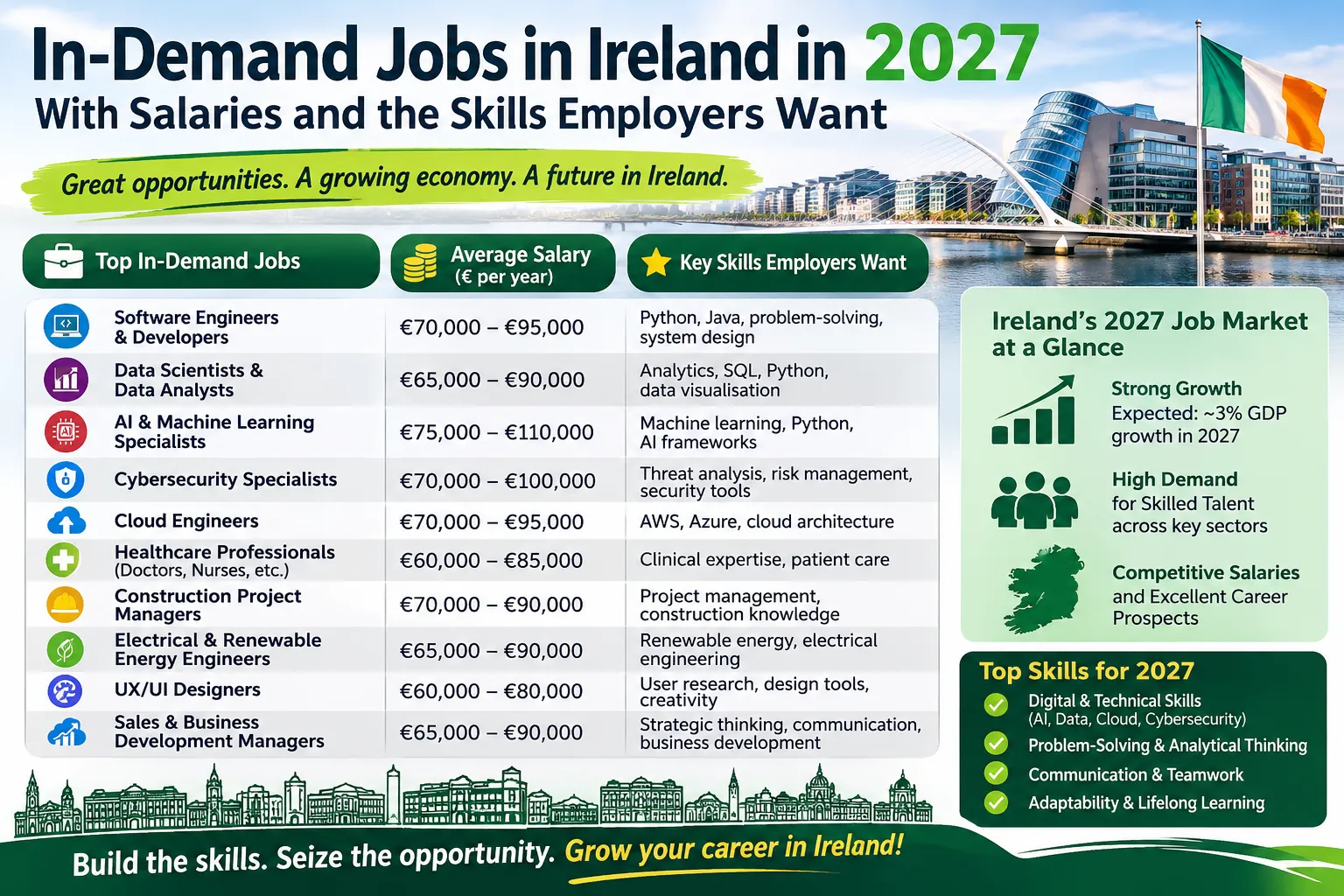
Ireland's job market has moved from a candidate-led rush to a more selective, skills-focused phase. Employers are still hiring, but they are choosing carefully, and the candidates who win offers are those who can prove specific, in-demand skills. If you are planning a move or a first job in 2027, knowing where demand sits, what roles pay, and what employers are screening for gives you a real advantage.
This guide draws on published 2026 salary and hiring surveys, which are the most recent full benchmarks available, and projects those trends into 2027. Treat every figure as indicative and check the latest guides before you negotiate.
A Selective Market With Real Skills Shortages
Recent Hays research found that 96% of Irish employers reported skills shortages, while 59% of professionals planned to change roles. In other words, talent is hard to find and workers are open to moving, yet pay growth has been modest. Hays reported average salary growth of around 2.3% in Ireland, with financial services higher at roughly 4%. Matrix Recruitment expected most sectors to stay broadly in line with 2025, with in-demand roles rising by 3% to 6%.
The message for job seekers is that premium pay goes to scarce skills, not to job titles alone. A financial controller, a data engineer, or a compliance specialist can command a clear premium, while general roles see flatter pay.
In-Demand Roles and Indicative Salaries
The table below shows examples of 2026 Dublin salary ranges published by Matrix Recruitment. Regional salaries are often lower, and actual offers depend on experience, sector, and company size.
Sector | Role | Dublin Range (2026) |
|---|---|---|
Finance | Financial Controller | €100,000 – €140,000 |
Finance | Risk Manager | €75,000 – €100,000 |
Finance | Financial Analyst | €60,000 – €70,000 |
Finance | Compliance Officer | €55,000 – €72,000 |
Quality | Quality Manager | €85,000 – €105,000 |
Quality | QC Technician | €45,000 – €60,000 |
Technology remains central to the market. Hays found that Irish tech salaries now compete with other major markets, averaging about €81,000, with a clear advantage in roles such as data engineers and solutions architects. Engineering and construction also stay competitive, and sustainability, quality, and compliance roles benefit from tighter regulation and reporting requirements.
Competition in Dublin is intense because the capital offers the highest advertised pay. Many applicants there work with a linkedin profile writer in Dublin to make sure their online profile supports their application as strongly as their CV does.
The Skills Employers Want in 2027
Hays' 2026 research found that digital and technology skills (50%) and technical, industry-specific expertise (48%) were expected to be the most in-demand, with AI literacy at the top of its soft-skills list. Leadership and people management, project management, and technical expertise were also named as the skills most likely to lead to higher pay.
In practice, employers are looking for:
AI literacy. You do not need to build models, but you should be able to use AI tools responsibly and explain how they improved your work.
Data and digital skills. Comfort with analytics, reporting tools, and automation is valued across finance, HR, sales, and operations.
Leadership and people management. Even without a formal title, evidence of mentoring, coordinating, or influencing others stands out.
Project management. Delivering on time and on budget is a skill every sector wants.
Regulatory and compliance knowledge. Roles tied to ESG, data protection, and financial regulation continue to grow.
Adaptability. Employers favour people who learn quickly as tools and processes change.
Skills only help if recruiters can see them. Many candidates now use resume makers in Ireland to structure their CV around measurable results and the keywords that applicant tracking systems scan for.
How to Break Into In-Demand Roles
If your current background does not match a growth area, there are practical routes in. Graduates can target structured programmes in finance, technology, and engineering. Career changers can use conversion courses, professional certifications, or short upskilling programmes to fill specific gaps. Internal moves are another option, since many employers prefer to promote or transfer trusted staff.
Whatever the route, tailor each application. Mirror the language of the job advert honestly, lead with achievements that match the role, and quantify your impact with figures such as budgets managed, costs saved, or targets exceeded.
Make Your Online Profile Work Harder
Recruiters in Ireland routinely search LinkedIn before they contact candidates, and a thin or outdated profile can cost you opportunities you never hear about. A specialist linkedin profile writing service ireland can help you build a keyword-rich headline, a clear About section, and an experience list that mirrors your CV. Consistency matters: your CV, cover letter, and profile should tell one coherent story about where you are going.
Choosing the Right Support
If you decide to get help, compare providers carefully. The best resume writing agency for you is one that asks detailed questions about your goals, shares anonymised samples, explains how it handles applicant tracking systems, and offers clear revision terms. Be cautious of anyone who guarantees interviews or sends a finished document without a consultation.
Final Thoughts
Ireland's 2027 job market rewards candidates who combine in-demand skills with clear proof of results. Study where demand is strongest, build the skills employers say they want, and present your experience in a way that software and people can both understand. For local, sector-aware support, a dedicated CV writing service in Ireland can help you turn that experience into interviews and offers.



Join the conversation
Discussion0
Join the conversation. Sign in to leave a response or reply to comments.