
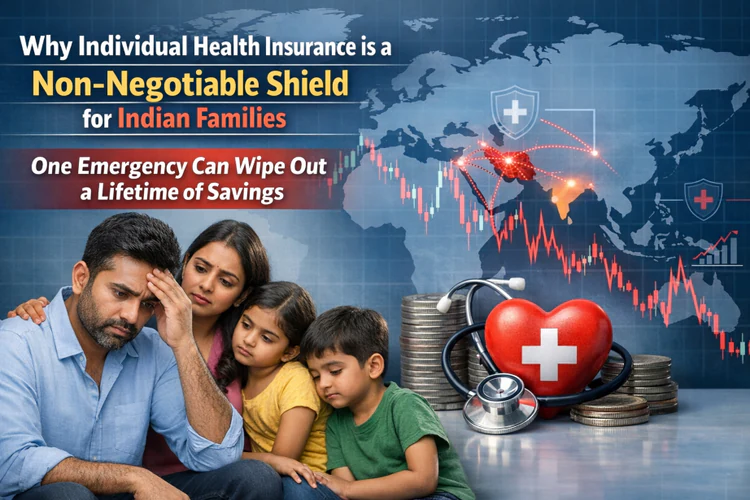
Why Individual Health Insurance is a Non-Negotiable Shield for Indian Families
A medical emergency doesn't knock before it enters. But when it does, it brings two crises — one for your body, and one for your bank account.
The Illusion of "We'll Manage When the Time Comes"
Most Indian families are built on resilience. We've always believed in tightening belts, borrowing from relatives, and managing somehow. For generations, that worked — because healthcare costs were manageable. A surgery cost a few thousand rupees. A week in hospital didn't mean selling your land.
That world no longer exists.
Today, a single hospitalization for a serious illness can cost anywhere between ₹2 lakh and ₹25 lakh — or more. Without health insurance, your family is just one diagnosis away from financial devastation.
The Shocking Reality of Hospital Bills
India's private healthcare has grown massively — and so have its bills. A heart bypass surgery costs ₹2.5–5 lakh. Cancer treatment can run ₹5–20 lakh. A single day in the ICU costs ₹15,000–₹50,000. These are not rare situations. Heart attacks, strokes, accidents, and dengue complications happen to ordinary families every single day.
Worse, India's medical inflation runs at approximately 14% per year — nearly double the general inflation rate. What costs ₹5 lakh today will cost ₹10 lakh in just five years. Even disciplined savings cannot keep pace with rising medical costs. Health insurance is the only financial tool that lets you transfer this escalating risk to an insurer — at a fraction of the actual cost.
One Emergency Can Wipe Out a Lifetime of Savings
This is the most sobering truth. Millions of Indian families have worked for decades — buying a home, building savings, securing their children's education — only to see it all unravel in weeks because of one major illness.
Consider this: A 45-year-old man suffers a heart attack and needs angioplasty. Total cost: ₹6 lakh. He has ₹4 lakh in savings. To bridge the gap, his family borrows from relatives, breaks the children's education fund, and spends the next two years repaying debt.
This is not hypothetical. This happens to lakhs of Indian families every year. A health insurance premium of ₹15,000–₹25,000 per year could have prevented all of it.
The Hidden Costs Nobody Anticipates
The hospital bill is only the beginning. A serious illness brings a cascade of expenses most families never see coming — pre- and post-hospitalization tests and medicines, loss of income if the earning member cannot work for weeks, caregiver costs, physiotherapy and rehabilitation, and travel if treatment requires going to another city.
Without insurance, every single rupee of these falls on your family. A comprehensive health plan covers most of these costs, turning a potentially ruinous situation into a manageable one.
Your Employer's Insurance is Not Enough
Many salaried Indians feel protected because their employer offers group health insurance. This safety net is far thinner than it looks. Coverage amounts are usually just ₹1–3 lakh — woefully inadequate for any serious illness. More critically, it ends the day you resign, get laid off, or retire. Parents and in-laws are often excluded entirely.
Relying solely on employer insurance is like wearing a paper raincoat in a storm. Individual health insurance ensures your family is covered regardless of where you work — or whether you work at all.
Waiting is the Costliest Mistake You Can Make
Many people plan to buy insurance "when they need it." This thinking is dangerously flawed.
Health policies have waiting periods of 2–4 years for pre-existing conditions. If you buy insurance after being diagnosed with diabetes or hypertension, your insurer won't cover related complications for years. Buy it in your healthy 20s or 30s, and you face no such restrictions.
Premiums also rise steeply with age. A 30-year-old can get a ₹10 lakh family floater for ₹12,000–₹18,000 per year. By 45, the same coverage costs ₹35,000–₹50,000 or more. Every year you delay, you pay more — for the same protection. The best time to buy health insurance was yesterday. The second-best time is today.
Your Parents and Children Need Protection Too
Indian families are multigenerational. You are responsible not just for yourself, but for your children, your parents, and sometimes your in-laws. Children face sudden fevers, accidents, and infections that escalate quickly. Elderly parents are at high risk for cardiac events, orthopaedics issues, and chronic diseases — all expensive to treat.
A family floater plan or individual policies for each member ensures that no matter who falls ill — your toddler or your 70-year-old mother — the financial blow is absorbed by the insurer, not by you.
Think of It as Your Family's Most Important Safety Net
We invest in mutual funds for wealth creation. We buy term insurance to protect against death. But a serious illness is statistically far more likely than an early death — and far more financially disruptive, because the bills keep coming while you are still alive and unable to earn.
For ₹1,500–₹2,500 a month, you are buying a guarantee that a medical emergency will not destroy everything you have built. That is not an expense. That is the smartest investment your family can make.
The Bottom Line
You have spent years earning, saving, and building your life. A single illness, without insurance, can undo it all — not metaphorically, but literally. The question is no longer "Do I need health insurance?"
The question is: "How much longer can I afford to live without it?"
Make the choice today — before a hospital bill makes the choice for you.


Join the conversation
Discussion0
Join the conversation. Sign in to leave a response or reply to comments.