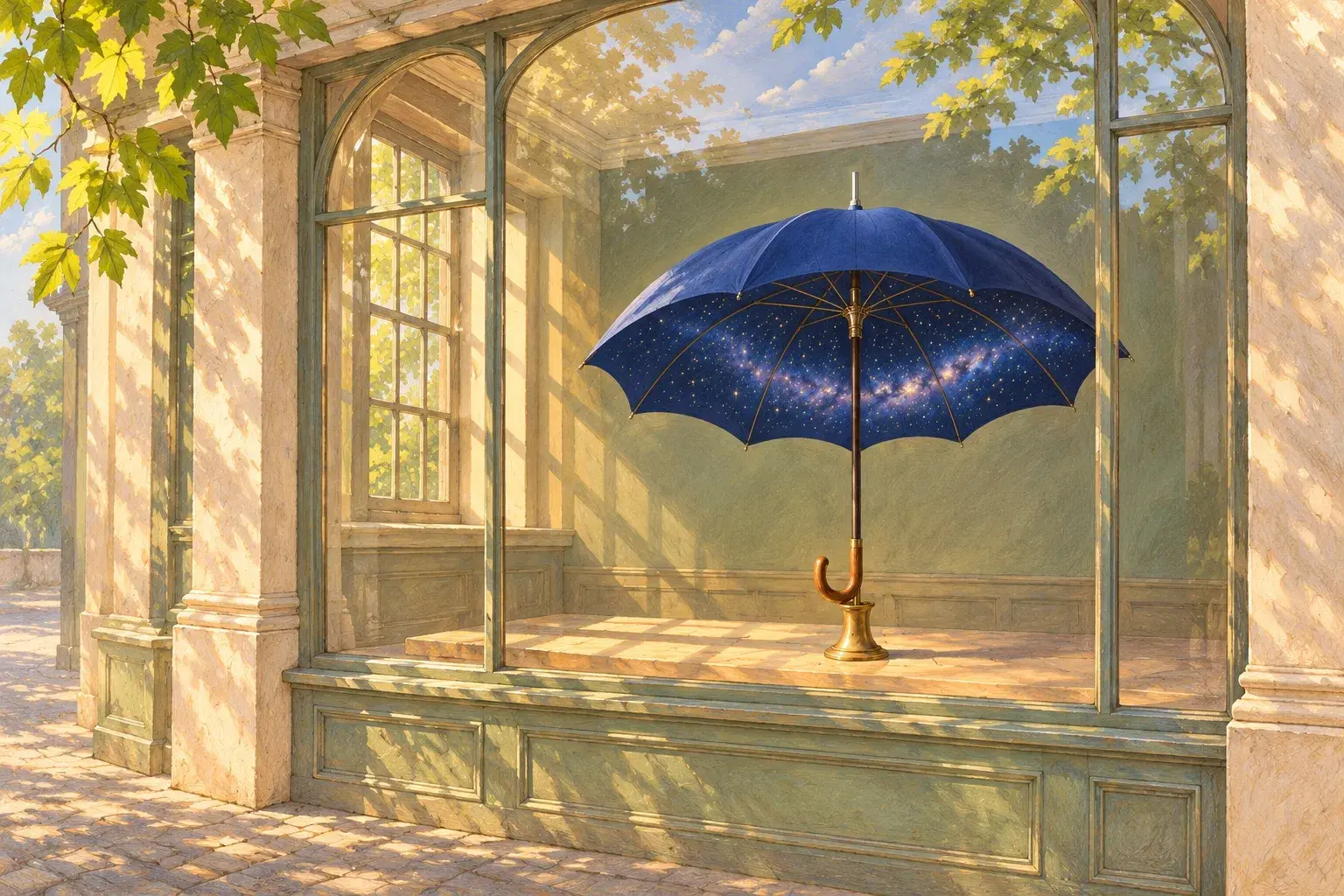
An original fictional advertisement concept. Night for Hire is an invented umbrella shop, and the little night it rents exists only in this imagined world.
Daylight can wait.
Open a little night.
Keep the rest of the day outside.Night for Hire
Borrow the evening.
The window is full of sunshine. So is the floor. In the middle of the shop stands one closed, dark-blue umbrella, looking quite incapable of improving the afternoon.
Then it opens.
Inside the canopy: a small, private sky. Stars between the ribs. A pale cloud of light where you expected lining. Outside it, the same bright day continues without noticing.

Night for Hire: the advertising idea in one image. The private night stays inside the canopy while daylight fills the shop. Original AI concept artwork, not a video result.
That is the whole advertisement. The shop does not sell a better forecast. It offers an impossible little escape: evening, within arm's reach, without waiting for the sun to go down.
The headline, two-line copy, shop name and invitation above form the finished written ad. Keep them as editable text when presenting the concept. The illustrations carry the visual idea without asking a model to spell the words inside the picture.
One umbrella. One opening. One borrowed evening.
The planned five-second shot begins in the ordinary daylit shop. A walnut hook handle rests above a small brass holder. The folded navy canopy conceals everything interesting.
The canopy opens while the camera stays still. As the lining comes into view, it becomes a pocket of starry night. The window, pale stone floor and rectangles of sunlight remain daytime. The last moment belongs to that contradiction: night is here, but only under the umbrella.
For sound, the creative direction is a gentle fabric swish followed by a quiet nocturnal atmosphere. No thunderclap, sales voice or spoken slogan is needed. Those are proposed sound choices, not audio that has been generated or heard.
A finished edit could place Daylight can wait. beside the opened canopy, followed by Night for Hire — Borrow the evening. Add that exact wording in a separate editor. If the copy needs a longer reading hold or an end card, make that a separate editing choice rather than assuming the five-second generator creates the whole finished advertisement.
Night for Hire, its rental service and this advertising scenario are invented. All four illustrations are original AI-created concept artwork. They are not frames from a Max Maker AI video, and no video-generation test is presented here.
The two images behind the opening
The closed reference keeps the same umbrella, holder, window and sunlit floor visible. It leaves room for the canopy to spread.

Start reference: the folded umbrella conceals the starry lining. This clean source concept is separate from the opening hero illustration.
The open reference gives the imagined shot its destination: the starry underside is visible, while the room remains bright.

End reference: the imagined reveal is visible under the open canopy. No generated transition or real umbrella mechanism has been tested.
These are separate closed and open source concepts, each 1672×941 pixels, close to 16:9. Their original proportions are preserved. They suggest compatible compositions, not a verified mechanical opening or a guaranteed transition between them. The hero illustration at the beginning is a different advertising composition; it is not the opening input. The extra cover is not an input either.
The plain pair keeps the small magic easy to see. It does not ask for a passer-by, a street full of changing weather or stars spilling out across the room. The shop can remain completely ordinary around its extraordinary umbrella.
A prompt for trying the five-second scene
A five-second continuous illustrated advertisement concept for an explicitly fictional umbrella shop. Use the supplied closed-umbrella start image and open-umbrella end image. One dark-blue umbrella opens in place on its small brass holder, revealing a star-filled midnight-blue interior between its ribs. Keep the walnut hook handle, holder, window, pale stone floor and camera steady. The surrounding shop remains bright ordinary daylight throughout; the private night appears only inside the canopy. Finish with the underside clearly visible. Refined layered gouache texture, warm sunlight and deep-blue starlight. No people, extra umbrellas, rain, room-wide darkness, camera movement, cuts, lettering or logos. Gentle fabric-opening sound and a quiet night atmosphere, no speech or thunder.
The instruction describes the intended illusion. It does not promise stable ribs, exact sound or a successful opening. Any actual candidate would need to be watched and heard before being used as a concept preview.
The official Max Maker AI page presents a “free minimax h3 video generator no signup required,” labels it unlimited and powered by MiniMax H3, and describes prompts or two frames becoming five-second clips with AI audio. Its free guided route uses both Start Frame and End Frame; text-only leaves both image fields empty. The page offers 16:9, 9:16 and 1:1, describes verification when prompted, a queue and one video processed at a time, with completed clips available in the current browser and a download option. These are provider descriptions, not independently tested results here. Unlimited does not mean simultaneous jobs or no waiting.
Tool suggestion: Max Maker AI is one option for trying this clearly labelled original creative concept.
For this attempt, put the closed reference into Start Frame, the open reference into End Frame, choose 16:9, and enter the prompt. Check any available upload framing preview; how the service crops or fits these images has not been tested. Select Generate, complete any requested verification, follow the queue, then preview and download a completed candidate you want to keep.
Three things would matter in that future preview: the umbrella still reads as the same object, the night stays inside its lining, and daylight remains outside. If the handle changes or the whole room turns dark, simplify or revise the references rather than calling the change part of the ad. Use a still concept if that tells the idea more faithfully. Add or adjust titles and sound externally; no built-in editing or mute control is assumed.
For sharing the proposal, a plain label is enough:
Original fictional ad concept for Night for Hire. AI-created reference illustrations; planned motion, not a filmed product or a completed commercial.
Then let the invitation do its small piece of work:
Borrow the evening.


Join the conversation
Discussion0
Join the conversation. Sign in to leave a response or reply to comments.