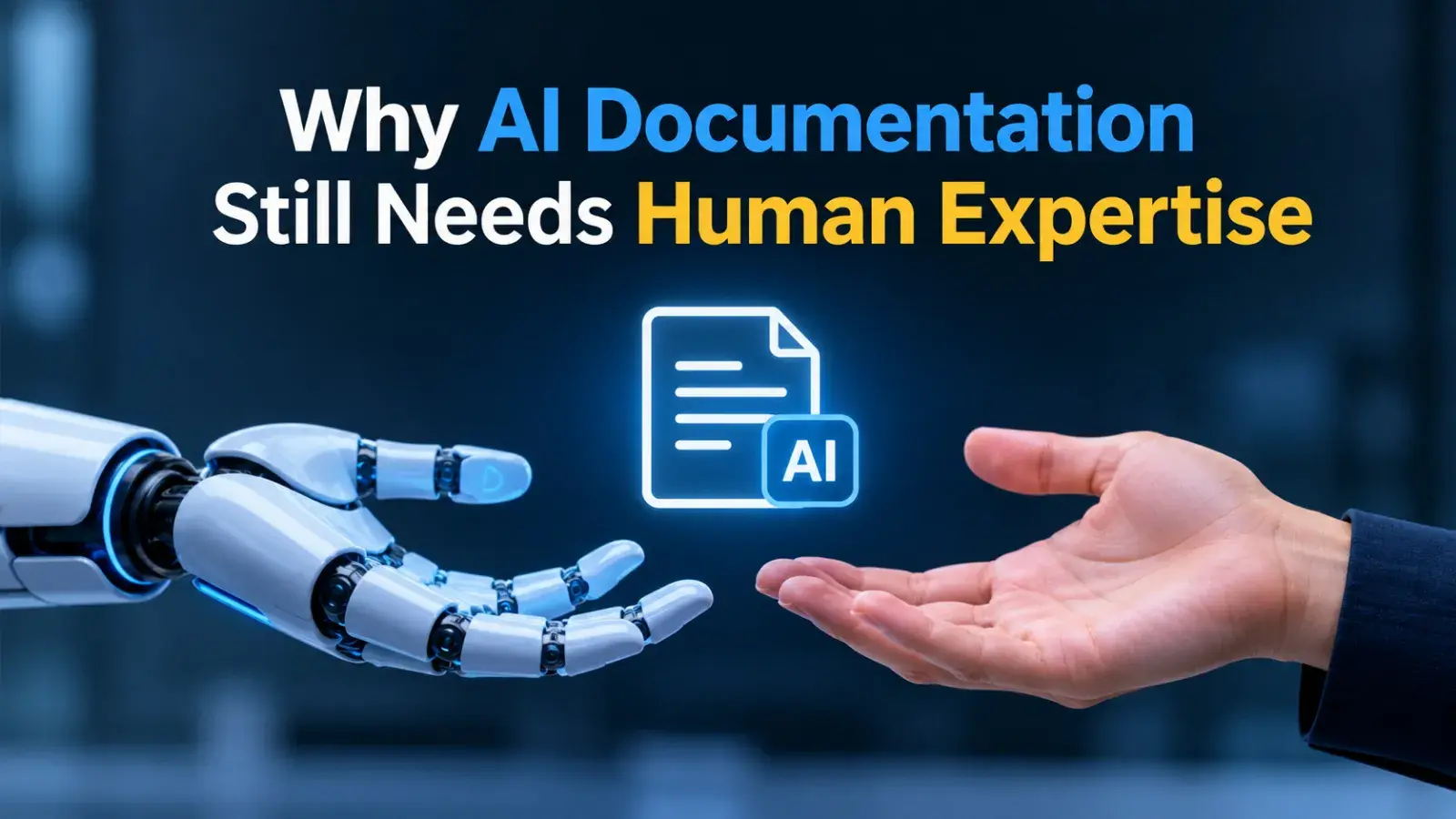
Artificial intelligence has made software documentation faster to produce, but it has not eliminated the engineering knowledge required to make that documentation reliable. Modern AI tools can examine source code, generate API descriptions, summarize development changes, and create technical guides within minutes. Yet a document that looks professionally written can still contain incorrect instructions, misunderstand application behavior, or overlook important business requirements. This is why organizations developing intelligent systems need structured and reliable information sources, such as an enterprise knowledge base for AI agents, to ensure that AI-generated explanations remain connected to accurate technical information.
The problem becomes more noticeable in complex software environments where one application may contain hundreds of interconnected components. A small change in authentication, database structure, or API behavior can affect multiple development teams. AI can describe the code it sees, but understanding why a particular decision was made requires context that may exist outside the codebase.
Human expertise is therefore not becoming less important. Instead, its role is shifting toward validating information, explaining technical decisions, identifying risks, and ensuring that documentation reflects how software actually works.
How AI Is Transforming Technical Documentation
Traditional documentation requires developers and technical writers to explain application functionality, describe system architecture, document APIs, and update instructions whenever a project changes.
This work is important, but it often competes with development deadlines. As a result, documentation updates may be delayed even when the software itself continues evolving.
AI is helping teams reduce this workload through several practical capabilities.
Automatic code explanations: AI can examine functions, classes, and modules to generate descriptions of their purpose and behavior.
API documentation generation: Tools can convert API specifications into endpoint descriptions, parameter explanations, and request examples.
Technical summarization: AI can summarize pull requests, release notes, architecture changes, and development discussions.
Documentation assistance: Developers can use AI to create README files, installation instructions, troubleshooting guides, and internal technical references.
Codebase exploration: AI assistants can help developers understand unfamiliar repositories by explaining how different files and components interact.
These capabilities make documentation easier to produce, particularly in projects where technical information changes frequently.
However, automation addresses the writing process more effectively than the question of whether the information is correct. A generated explanation still needs to be checked against the actual implementation and the requirements it is supposed to describe.
Why AI-Generated Documentation Can Contain Serious Mistakes
One of the most challenging aspects of AI documentation is that incorrect information can look convincing.
A language model may generate a clear explanation using outdated technical references or incomplete project context. The result can appear professional while quietly misleading developers.
Consider a SaaS application with a subscription management system.
An AI tool examines the subscription API and generates documentation explaining how customers can upgrade or cancel their plans. The explanation accurately describes the API parameters.
However, it misses an important business rule: customers with outstanding invoices cannot immediately cancel certain subscription types.
The documentation may be technically accurate at the endpoint level but incomplete from an operational perspective.
Several factors contribute to these problems.
1. Missing Business Context
Source code does not always explain the reasons behind technical decisions.
A developer might implement a particular validation rule because of a contractual requirement, regional regulation, or internal business policy.
AI can identify the validation logic, but it may not understand why the rule exists or what happens if it is removed.
Human reviewers can connect technical implementation with business requirements and explain the reasoning that future developers need to understand.
2. Outdated Technical References
Software documentation becomes unreliable when it does not reflect the latest version of an application.
For example, a team might replace an authentication library but forget to update its installation guide.
An AI tool using the old documentation as its source may reproduce the same outdated instructions.
This creates a situation where automation unintentionally increases the distribution of incorrect information.
3. Missing Edge Cases
Many technical guides explain the normal workflow but overlook unusual situations.
A user registration guide, for instance, should consider more than creating an account.
It may also need to explain:
Duplicate email addresses.
Expired verification links.
Invalid authentication tokens.
Suspended accounts.
Rate limiting.
Failed email delivery.
Unexpected server responses.
Developers with practical experience are better positioned to recognize which scenarios deserve attention.
4. Incorrect Code Examples
Generated code examples are useful only when they work with the actual software environment.
An example might reference an outdated library method, use an incorrect parameter, or ignore a required permission.
A developer following those instructions could spend hours troubleshooting a problem caused by the documentation itself.
Human verification helps prevent these avoidable mistakes.
The Difference Between Explaining Code and Understanding Software
A major limitation of automated documentation is the difference between describing an implementation and understanding the system behind it.
Imagine an e-commerce platform with separate services for orders, payments, inventory, and customer accounts.
An AI tool may successfully describe each service individually. However, the complete purchasing process involves relationships between them.
When a customer places an order, the application may need to:
Validate the customer's account.
Check product availability.
Calculate taxes and delivery costs.
Process the payment.
Update inventory.
Generate an order confirmation.
Trigger a delivery workflow.
If payment succeeds but inventory updates fail, the application needs a defined recovery process.
A developer who understands the architecture can explain how the system handles this situation, including retries, transaction boundaries, and failure recovery.
AI-generated documentation may describe the individual functions without explaining the complete operational workflow.
That difference matters because developers generally need documentation to understand how systems behave together, not simply what individual functions do.
Where Human Expertise Makes the Biggest Difference
Human involvement should not be limited to correcting spelling or improving sentence structure after AI generates a document.
The most valuable contribution comes from evaluating whether the information is accurate, complete, secure, and useful for its intended audience.
Understanding Architectural Decisions
Architecture documentation explains how software components interact and why particular design choices were made.
For example, a development team might introduce caching because repeated database queries are affecting application performance.
AI can describe the caching implementation, but an experienced engineer can explain:
Why caching was necessary.
Which information is cached.
How frequently cached information expires.
What happens when the cache becomes unavailable.
Which components depend on the cached data.
These details help developers understand the system rather than simply copy its implementation.
Identifying Security Risks
Technical documentation often contains instructions related to authentication, authorization, data handling, and external integrations.
An inaccurate explanation in these areas can introduce security problems.
For example, documentation should distinguish between authentication, which verifies identity, and authorization, which determines what an authenticated user can access.
Human security reviewers can also identify unsafe examples, exposed credentials, missing permission checks, and insecure configuration practices.
Making Documentation Useful for Different Readers
A junior developer and an experienced software architect do not need the same explanation.
A junior developer may need installation instructions and a basic explanation of the application's structure.
An experienced engineer may need information about service dependencies, database migrations, API contracts, and deployment architecture.
Human technical writers can organize information around the reader's actual requirements instead of generating explanations that are unnecessarily complicated.
How AI Documentation Should Be Reviewed Before Publication
A reliable review process should combine automated checks with human technical judgment.
The following workflow provides a practical starting point for development teams.
Step 1: Identify the Authoritative Information
Before generating documentation, determine which technical sources should be trusted.
These may include:
Current source code.
Approved API specifications.
Database schemas.
Architecture diagrams.
Internal development standards.
Security policies.
Existing technical decisions.
Teams should identify deprecated files and outdated references before using them as inputs.
This reduces the possibility of generating documentation from incorrect information.
Step 2: Generate the Initial Draft
Use AI to prepare an initial version of the documentation.
For example, a developer can provide an API specification and request an explanation covering endpoints, authentication requirements, parameters, responses, and common errors.
The purpose is to save time on repetitive writing while keeping the final technical decisions under human control.
Step 3: Assign an Experienced Reviewer
A developer familiar with the relevant application should review the generated content.
The review should establish whether the documentation:
Matches the actual implementation.
Explains important business rules.
Includes necessary configuration details.
Covers relevant edge cases.
Uses correct technical terminology.
Avoids insecure recommendations.
If an explanation depends on information that is not available, the reviewer should request clarification instead of allowing AI to invent missing details.
Step 4: Test Technical Examples
Code snippets, API requests, and installation instructions should be tested wherever possible.
For example, a setup guide should be followed in a clean development environment to confirm that its commands and configuration steps actually work.
Similarly, API examples should be checked against a test environment or an appropriate automated validation process.
Step 5: Approve and Publish the Documentation
Once technical accuracy has been established, the content can move through the organization's normal documentation approval process.
Important documentation should have an identifiable owner, version information, and a review schedule.
This creates accountability when application behavior changes.
AI Documentation Across Different Development Areas
The amount of human review required depends on the type of documentation being produced.
Some documentation tasks are relatively straightforward to automate, while others require a deeper understanding of application architecture and business operations.
Documentation type | What AI can help with | What humans must verify |
API documentation | Endpoint descriptions and examples | Parameters, permissions, responses |
Architecture guides | Component summaries | Dependencies and design decisions |
Database documentation | Schema explanations | Business meaning and relationships |
User guides | Step-by-step instructions | Actual user workflows |
Security documentation | Initial technical summaries | Security policies and vulnerabilities |
Developer documentation | Setup guides and code examples | Compatibility and practical accuracy |
This division of responsibilities allows development teams to use AI efficiently without treating generated content as automatically approved information.
Why Documentation Maintenance Matters More Than Initial Generation
Creating a technical document is only the beginning. Keeping it accurate as software evolves is a much larger responsibility.
Consider a business application that initially supports email-based authentication.
Later, developers introduce social login, multi-factor authentication, and role-based permissions.
The original authentication guide may still explain how email verification works, but it no longer represents the complete authentication architecture.
If developers continue following the old instructions, they may misunderstand how users access the application or how permissions are managed.
This problem becomes particularly serious in enterprise applications where multiple teams rely on the same technical references.
A practical documentation maintenance process should include:
Version tracking: Every important document should identify the application version or technical release it describes.
Ownership: A responsible person or team should be assigned to important documentation.
Change detection: Significant code, API, or database changes should trigger a documentation review.
Scheduled audits: Frequently used technical guides should be reviewed regularly.
Feedback collection: Developers should have a straightforward way to report unclear or incorrect instructions.
Documentation should also be evaluated against real development questions rather than simply checking whether every page has been updated recently.
For example, if developers repeatedly ask how to configure a particular service, the relevant guide may need clearer instructions even if its technical information is still accurate.
The Role of Data Quality in Reliable AI Documentation
AI documentation systems depend heavily on the information supplied to them.
If an organization provides incomplete, outdated, or contradictory technical material, generated explanations may reflect those problems.
This makes data quality an important part of documentation reliability.
The same principle appears in machine learning, where separating training, validation, and test data helps establish whether a model performs reliably on information it has not already learned from. Understanding training, validation, and test data also helps explain why AI-generated results should be evaluated independently rather than accepted simply because they appear convincing.
For documentation workflows, teams can apply a similar mindset:
Use approved sources for content generation.
Keep outdated references separate.
Validate generated explanations against current implementations.
Test examples in appropriate environments.
Review the results using real developer questions.
This creates a stronger foundation for technical documentation and reduces the risk of repeatedly publishing the same incorrect information.
Why Documentation Needs Both Technical and Editorial Expertise
Technical accuracy is essential, but documentation must also communicate information clearly.
A technically correct document can still fail if it contains confusing explanations, poor organization, or unnecessary terminology.
This is where technical writers and editors contribute alongside software engineers.
A developer may understand the complete implementation but struggle to explain it to someone unfamiliar with the project.
A technical writer can improve the structure, simplify explanations, and organize the information into a logical sequence.
AI can support both roles by preparing drafts, suggesting headings, and improving readability.
For organizations and writers sharing technical knowledge through publishing platforms such as CandyWrite, the same principle applies: useful content needs a clear purpose, meaningful explanations, and careful editorial review rather than simply more generated words.
The strongest results come from combining subject knowledge with effective communication.
How Companies Can Build a Sustainable AI Documentation Workflow
Organizations should treat documentation as an ongoing part of software engineering instead of an isolated writing activity.
A sustainable workflow can be built around five practical principles.
1. Make Documentation Part of Development Tasks
When developers introduce a new feature or modify an existing service, documentation updates should be considered part of the work.
This prevents technical references from becoming disconnected from the application.
2. Use AI for Repetitive Activities
AI can handle initial drafts, code explanations, formatting, summaries, and documentation suggestions.
Developers can then spend more time reviewing important technical details.
3. Establish Clear Review Responsibilities
Not every document requires the same level of approval.
A simple README update may need a developer review, while authentication or payment documentation may require additional security and architecture checks.
4. Automate Documentation Validation
Teams can introduce automated checks for broken links, outdated code examples, missing API references, and formatting problems.
These checks cannot replace human judgment, but they can identify common issues before publication.
5. Measure Documentation Effectiveness
Companies should examine whether documentation actually helps developers complete tasks.
Useful indicators include:
Time required to onboard new developers.
Number of repeated technical questions.
Documentation-related defects.
Accuracy of code examples.
Frequency of outdated information.
Developer feedback.
These measurements help organizations identify which documentation deserves improvement.
What the Future of AI-Assisted Documentation Looks Like
The next generation of documentation tools will likely become more closely integrated with development environments.
Instead of waiting for developers to manually update every document, AI systems may identify changes in source code and recommend updates to the relevant technical guides.
Imagine a developer modifying an API endpoint.
An integrated documentation assistant could detect the change, identify related documentation, generate an updated explanation, and highlight sections that require technical confirmation.
A human reviewer could then examine the proposed changes before publication.
This approach could make documentation maintenance more continuous and reduce the gap between software implementation and written instructions.
However, automated change detection cannot always understand the business reason behind a modification.
A developer might change an API because of a new compliance requirement or an important architectural decision. That context should be documented explicitly rather than inferred from the code.
The future will therefore depend on collaboration between intelligent tools and experienced professionals.
Final Thoughts
AI is making software documentation faster, more accessible, and easier to maintain. It can explain source code, generate API references, summarize development changes, and help teams produce technical guides with less repetitive effort.
But documentation quality depends on more than the ability to generate text.
Reliable documentation must explain actual software behavior, preserve important engineering decisions, identify limitations, and help developers solve real problems.
AI can assist with the writing process, but experienced professionals remain essential for validating technical information, recognizing security risks, and ensuring that explanations reflect the complete system.
For businesses investing in intelligent software solutions, AI governance and accountability should also extend to the information their systems generate, maintain, and distribute.
Ultimately, the best documentation is not the documentation produced in the shortest time. It is the documentation developers can depend on when building, maintaining, and improving software.
Frequently Asked Questions
1. Why does AI-generated documentation need human expertise?
AI-generated documentation needs human expertise because automated tools may misunderstand business logic, miss important edge cases, or use outdated technical information. Human reviewers verify that explanations match the actual software and its requirements.
2. Can AI completely replace technical writers?
No. AI can help generate drafts, organize information, and improve readability, but technical writers contribute audience awareness, editorial judgment, and clear communication. Developers also provide the technical knowledge required to validate complex explanations.
3. What are the biggest risks of AI-generated documentation?
The main risks include inaccurate technical descriptions, outdated instructions, missing security requirements, incorrect code examples, and incomplete explanations of business logic.
4. How can developers improve AI documentation quality?
Developers can improve quality by using authoritative sources, providing sufficient project context, reviewing generated content, testing code examples, and updating documentation whenever important software changes occur.
5. How often should software documentation be updated?
Documentation should be reviewed whenever relevant software behavior changes. Frequently used guides, security instructions, and API references should also have scheduled reviews to identify outdated information.
6. Is AI useful for API documentation?
Yes. AI can generate endpoint descriptions, explain request parameters, prepare response examples, and summarize API changes. However, developers should verify authentication rules, error handling, compatibility, and actual endpoint behavior before publishing.

Join the conversation
Discussion0
Join the conversation. Sign in to leave a response or reply to comments.