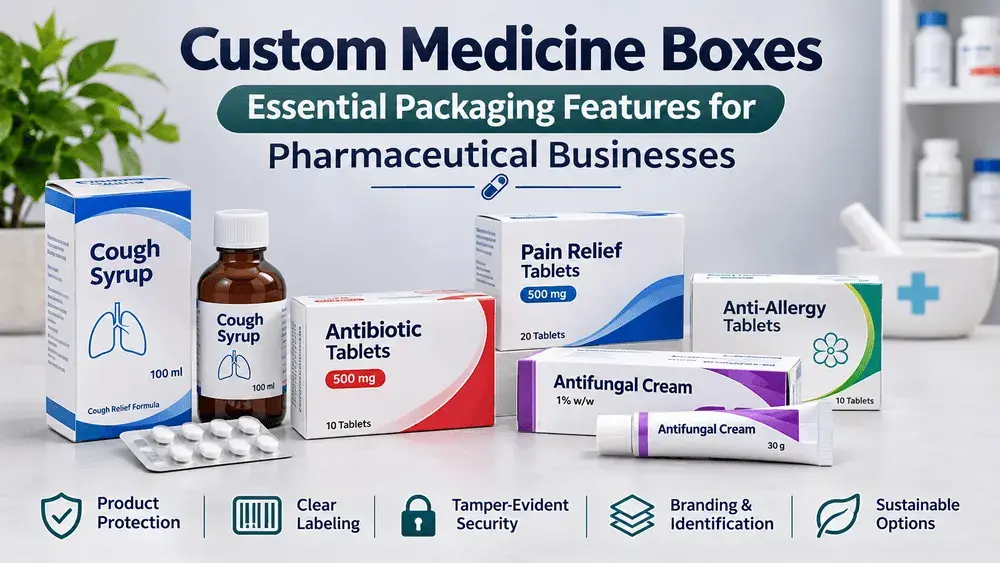
Pharmaceutical packaging serves a greater purpose than simply holding a product. It must protect medicines, communicate important instructions, and help healthcare professionals and patients identify products correctly. From tablet cartons to injectable medicine packaging, custom medicine boxes allow pharmaceutical businesses to address specific product requirements while maintaining consistent quality and presentation. Choosing suitable materials, accurate dimensions, readable labeling, and functional box structures can reduce packaging-related problems. Understanding these essential features helps pharmaceutical manufacturers develop packaging that supports patient safety, regulatory compliance, and efficient product distribution.
Understanding the Purpose of Pharmaceutical Packaging
Pharmaceutical packaging is generally divided into primary, secondary, and tertiary packaging. Primary packaging includes containers that directly contact medicines, such as blister packs, bottles, and vials. Secondary packaging provides additional protection and space for printed information, while tertiary packaging supports transportation and bulk distribution.
Custom pharmaceutical boxes primarily function as secondary packaging. They organize packaged medicines, support product identification, and protect primary containers against physical damage. Pharmaceutical businesses should understand these differences before establishing their packaging specifications.
Choose Suitable Materials for Medicine Boxes
Material selection affects packaging durability, printing quality, manufacturing costs, and storage performance. Pharmaceutical businesses should select materials according to product weight, container dimensions, and distribution conditions.
Packaging Material | Suitable Applications | Main Benefit |
SBS paperboard | Tablets and capsules | Clear, high-quality printing |
Kraft paperboard | Selected healthcare products | Reduced need for decorative finishes |
Corrugated cardboard | Bulk medicine shipments | Additional cushioning |
Folding boxboard | Syrups and ointments | Lightweight construction |
Rigid cardboard | Specialized healthcare kits | Structural strength |
Paper-based cartons provide physical protection but cannot replace validated primary packaging for medicines requiring moisture, oxygen, or temperature control.
Select Functional Box Styles for Different Medicines
Pharmaceutical products have different shapes, sizes, and handling requirements. Selecting an appropriate medicine products box can improve storage efficiency and make packaging easier to assemble.
Common medicine box styles include:
Straight tuck-end boxes for tablet blister packs.
Reverse tuck-end boxes for creams and ointments.
Auto-lock bottom boxes for heavier medicine bottles.
Partitioned boxes for vials and ampoules.
Dispenser boxes for individually packaged medicines.
Corrugated boxes for bulk pharmaceutical distribution.
Internal inserts can help organize fragile containers, measuring cups, droppers, and patient information leaflets. Packaging dimensions should accommodate these components without creating excessive empty space.
Ensure Clear and Accurate Medicine Labeling
Printed medicine boxes must communicate essential information in a readable and organized format. Incorrect or confusing labeling can increase the risk of medication errors, making artwork accuracy particularly important.
In the United States, FDA labeling requirements vary according to the pharmaceutical product category. Depending on applicable regulations, medicine packaging may need to display:
Medicine name and strength
Active ingredients
Dosage instructions
Batch or lot number
Expiration date
Storage instructions
Manufacturer or distributor details
Applicable warnings and precautions
Many over-the-counter medicines must follow the standardized Drug Facts labeling requirements established under 21 CFR 201.66. Pharmaceutical businesses should obtain regulatory approval of their artwork internally before printing.
Improve Pharmaceutical Packaging with We Print Boxes
Pharmaceutical businesses exploring packaging solutions through We Print Boxes can develop packaging specifications based on product dimensions, material preferences, printing requirements, and order quantities. Well-designed Custom Boxes should accommodate both the primary medicine container and necessary accompanying information.
Before ordering, businesses should prepare accurate measurements, approved artwork, structural requirements, and coding specifications. Reviewing a physical sample allows manufacturers to identify potential design problems before committing to full-scale production. This approach helps reduce material waste, manufacturing delays, and unnecessary expenses.
Incorporate Tamper-Evident Packaging Features
Tamper-evident packaging helps patients and healthcare professionals recognize whether a product may have been opened or altered before use. This feature is particularly important for medicines distributed through pharmacies, retail stores, and online healthcare platforms.
Packaging features may include security seals, perforated opening strips, and sealed carton closures. Under 21 CFR 211.132, most OTC human drug products sold at retail must meet applicable tamper-evident packaging requirements, subject to specified exceptions.
However, tamper-evident features should not be confused with child-resistant packaging. Pharmaceutical manufacturers must independently evaluate both requirements according to the product and applicable regulations.
Support Product Traceability with Barcodes
Effective pharmaceutical traceability helps businesses identify products throughout the supply chain. Batch numbers, expiration dates, and machine-readable codes support inventory management, distribution monitoring, and product recalls.
Under the Drug Supply Chain Security Act (DSCSA), certain prescription drugs require package-level product identifiers that support electronic tracing within the United States.
Businesses designing custom medicine packaging boxes should reserve suitable printing areas for variable information. Barcode readability should be tested on finished packaging because surface coatings, poor contrast, and printing defects can interfere with scanning.
Maintain Professional Branding and Product Identification
Pharmaceutical branding should prioritize clarity rather than excessive decoration. Consistent typography, organized layouts, and recognizable brand elements can help healthcare professionals and patients identify products.
Custom Boxes with Logo allow manufacturers to maintain a consistent visual identity across different medicine categories. However, clearly displaying medicine names and strengths should remain the primary design consideration.
Different products should be distinguishable to reduce potential confusion between similar-looking cartons. Color variations can support identification but should never replace readable product names and dosage information.
Manage Production Costs with Medicine Boxes Wholesale
Ordering medicine boxes wholesale can help pharmaceutical businesses manage packaging expenses, particularly when products require regular inventory replenishment.
Consider this hypothetical production cost comparison:
Order Quantity | Cost per Box | Total Cost |
1,000 boxes | $0.65 | $650 |
2,500 boxes | $0.45 | $1,125 |
5,000 boxes | $0.30 | $1,500 |
Businesses purchasing Custom Boxes Wholesale should consider production schedules, storage capacity, expected demand, and potential labeling changes. Excessive inventory can result in financial losses if medicine specifications or regulatory requirements change.
Adopt Sustainable Pharmaceutical Packaging Practices
Pharmaceutical businesses can reduce packaging waste by selecting appropriately sized cartons, minimizing unnecessary components, and considering recyclable paper-based materials.
Sustainable Custom Packaging may include responsibly sourced paperboard, removable cardboard inserts, and fewer plastic-based decorative finishes. However, recyclability depends on material composition and local recycling facilities.
Environmental objectives must never compromise medicine stability, patient safety, or regulatory compliance.
Conduct Quality Checks Before Mass Production
Packaging quality control helps pharmaceutical manufacturers identify defects before products enter distribution. Physical samples should be evaluated against approved structural and artwork specifications.
Important quality checks include dimensional accuracy, carton strength, closure functionality, printing consistency, barcode readability, and label accuracy. Where necessary, qualified professionals should conduct transportation and product compatibility testing.
Maintaining documented packaging approval procedures can support consistent manufacturing standards and reduce the likelihood of packaging-related product recalls.
Conclusion
Custom medicine boxes play an important role in pharmaceutical product protection, identification, traceability, and patient safety. Businesses should prioritize suitable materials, functional structures, accurate labeling, tamper-evident features, and consistent quality control. By balancing regulatory requirements with production efficiency and responsible material selection, pharmaceutical companies can develop reliable packaging solutions that support their operational needs and healthcare responsibilities.
Frequently Asked Questions (FAQs)
What are custom medicine boxes?
They are customized secondary packaging cartons designed for pharmaceutical products, including tablets, syrups, capsules, and ointments.
Which material is best for medicine boxes?
SBS paperboard and folding boxboard are common choices for lightweight pharmaceutical retail packaging.
Can medicine boxes include tamper-evident features?
Yes, suitable security seals, perforated strips, and sealed closures can provide tamper-evident features.
Are wholesale medicine boxes cost-effective?
Larger production quantities may reduce per-unit packaging costs, depending on manufacturing specifications.
What information should medicine boxes display?
Applicable information may include medicine names, strengths, ingredients, expiration dates, storage instructions, and safety warnings.
Join the conversation
Discussion0
Join the conversation. Sign in to leave a response or reply to comments.