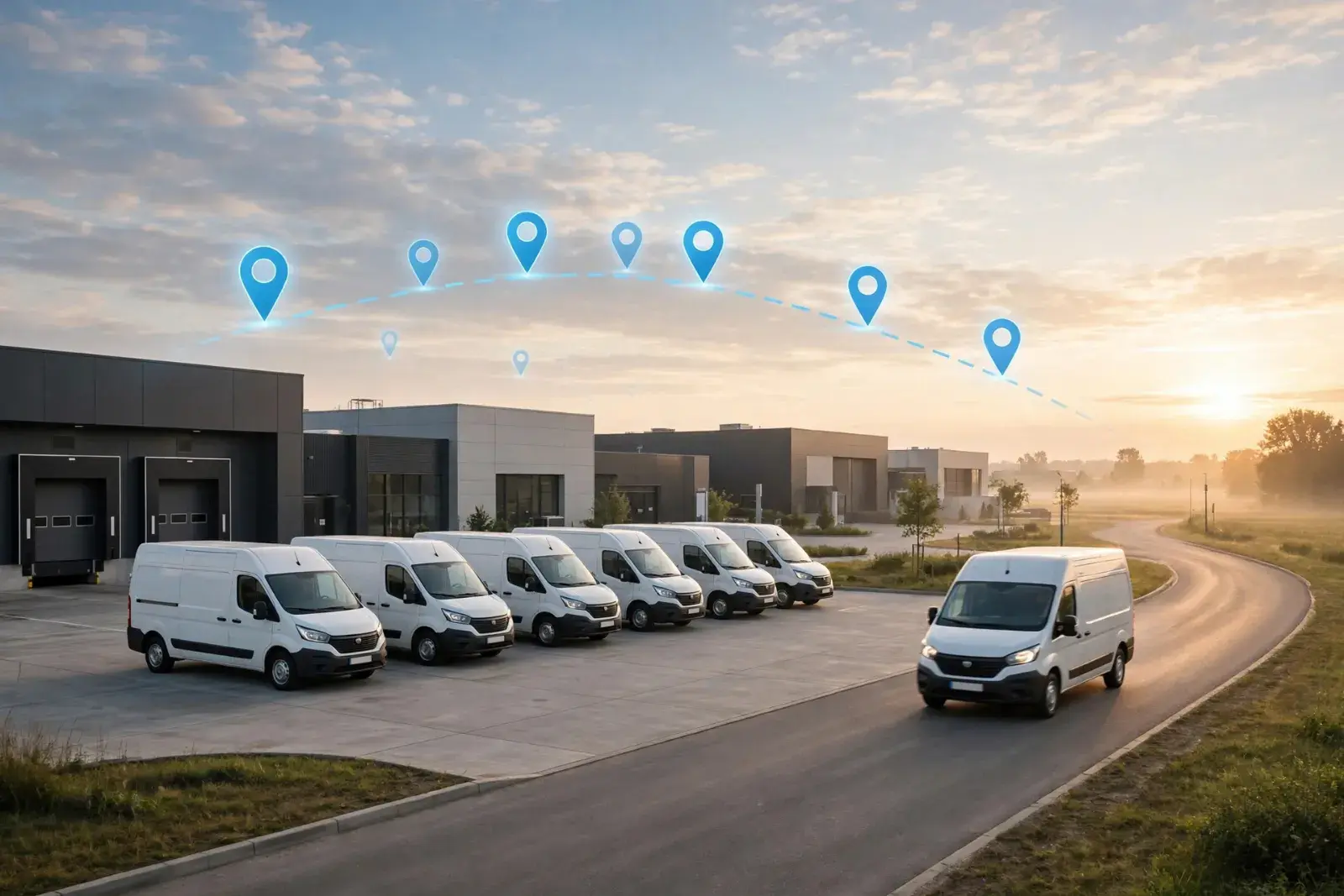
Ask the owner of a two-van business about fleet management systems and you will often hear the same sentence: "We're too small for that." The assumption is that tracking is a big-fleet tool — something for logistics departments and compliance teams. Spend time with small operators who do track, though, and a different picture emerges: the smaller the fleet, the more each vehicle's behaviour matters, and the faster good data pays for itself.
Why Small Fleets Resist Systems
The resistance is understandable. A two-van operator knows both drivers personally, often works alongside them, and feels that a dashboard would formalise what trust already handles. There is also the arithmetic of attention: every hour spent on systems is an hour not spent on the work itself. What this misses is that the owner is usually the fleet's biggest blind spot — the one driving the other van, unable to see the round they are not on, reconstructing the day from fuel receipts and customer calls.
The Two-Van Advantage
Small fleets hold one card the big ones envy: they can act on data the same day. There is no committee between the report and the fix. The owner who sees idling doubling on one round can ask about it at the yard that evening, learn the site gate opens twenty minutes after arrival, and change the schedule before tomorrow. A tracking system for vehicle in a small business is less a management layer than a memory — an accurate record of journeys, times and stops that settles the small daily questions (when did we actually get there, how long did that job take, why did Tuesday cost so much fuel) that otherwise get answered by guesswork and occasionally by argument.
Costs That Bite Harder at Small Scale
Proportionally, small fleets carry heavier versions of the same costs. One van off the road is half the fleet, not two percent of it, so the maintenance warning ignored on Monday is a cancelled week, not a reshuffle. One underpriced contract can be a third of turnover, which makes the true cost-per-job data — journey time, mileage, waiting — a pricing tool, not a curiosity. And fuel waste that a large fleet absorbs as noise can be the entire profit margin of a small round. The case for measurement does not shrink with the fleet. It concentrates.
Growing Into the Data
The operators who benefit most start narrow: journey history and arrival times first, because customers ask about those daily; idling and fuel second, because the savings are visible within a month; driver scores last, if at all, because in a team of three the conversation matters more than the metric. What they are really building is the habit that growth will demand anyway — records that do not depend on memory, prices based on measured costs, promises based on measured times. The business that learns this at two vans scales it to ten without pain. The one that waits until ten learns it under pressure, with ten times the chaos to untangle.
Discipline Scales Down
The lesson of the two-van fleet is that fleet discipline was never about fleet size. It is about whether the business runs on records or on recollection. Tracking simply makes records effortless — the journeys log themselves, the times stamp themselves, and the owner gets to spend their judgement on decisions instead of detective work. Small is not a reason to skip the system. Done lightly, small is where the system shines brightest.


Join the conversation
Discussion0
Join the conversation. Sign in to leave a response or reply to comments.