
In the annals of scientific history, few names carry as much weight as that of Muhammad ibn Musa al-Khwarizmi. While his name may not be instantly recognizable to everyone, its legacy is embedded in the very fabric of the modern world. He was a Persian polymath who flourished during the Islamic Golden Age in 9th-century Baghdad, and his groundbreaking work in mathematics, astronomy, and geography laid the foundation for disciplines that would shape human civilization for centuries to come. From the algebra we learn in school to the algorithms that power our smartphones, Al-Khwarizmi's influence is everywhere.

Early Life and the House of Wisdom
Details about Al-Khwarizmi's early life are scarce. He was likely born around 780 CE, and it is believed his family originated from Khwarizm (modern-day Khiva in Uzbekistan), which is how he acquired his name. He rose to prominence as a scholar in Baghdad at the famed House of Wisdom (Bayt al-Hikmah), a magnificent center of learning established by the Abbasid Caliph al-Ma'mun.
As the BBC Radio 3 explains, the House of Wisdom was “a renowned centre of scientific research and teaching in his time - attracting some of the greatest minds of the Islamic Golden Age”. Al-Khwarizmi was one of the learned men who worked there under the leadership of Caliph al-Mamun. The Library of Congress also confirms he was a “scholar in the famed House of Wisdom in Baghdad”. Working alongside other great minds, such as the Banu Musa brothers and Al-Kindi, Al-Khwarizmi immersed himself in the study of mathematics, astronomy, and geography, a fertile environment that would nurture his greatest discoveries.
The Birth of Algebra
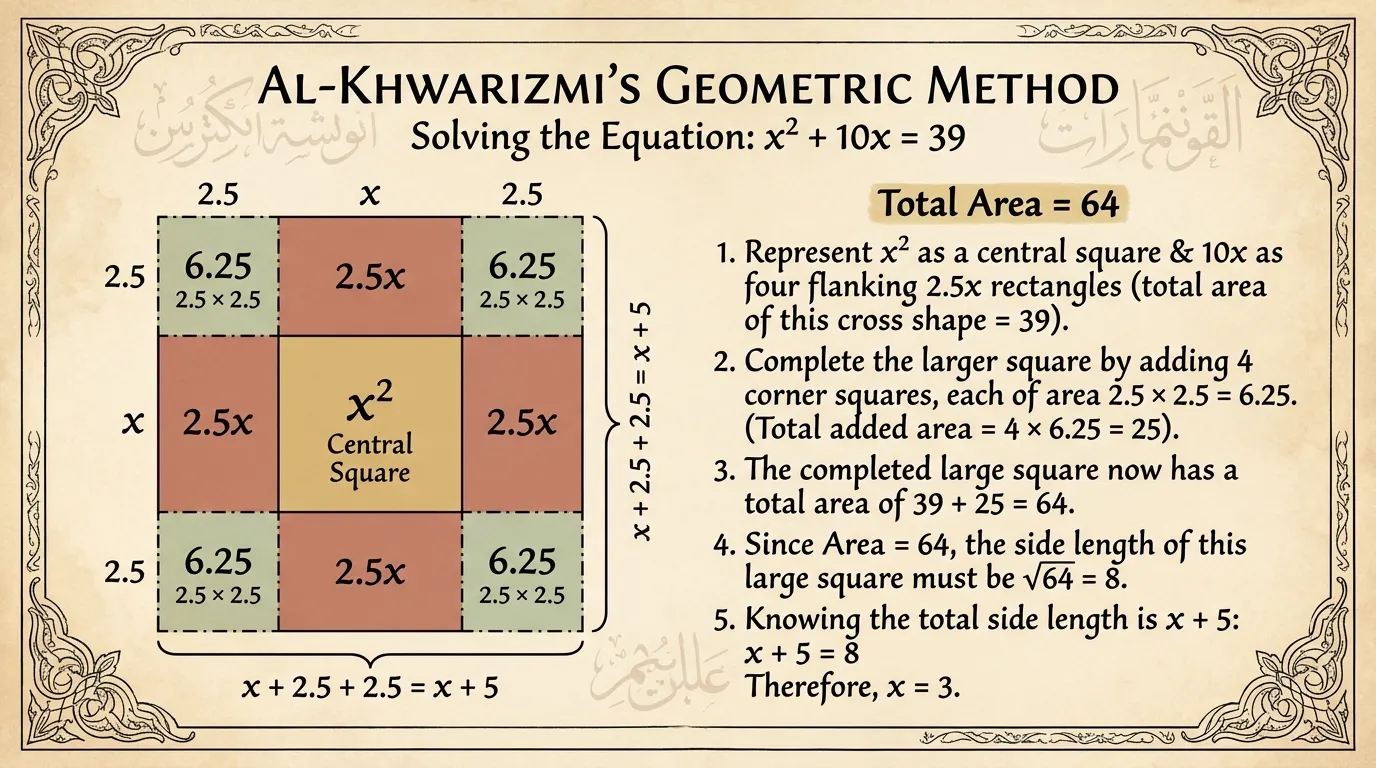
Al-Khwarizmi's most celebrated contribution is his foundational work on algebra. Around 820 CE, he authored "Al-Kitab al-mukhtasar fi hisab al-jabr wa'l-muqabala" (The Compendious Book on Calculation by Completion and Balancing). This treatise was the first to present algebra as a systematic, independent mathematical discipline.
The very word "algebra" is derived from al-jabr, one of the two operations he introduced for solving equations. As the Library of Congress notes, this book was “meant to be a useful work, with examples and applications for everyday life, in areas such as trade, legal inheritance, and surveying”. Al-Khwarizmi laid out a comprehensive method for solving linear and quadratic equations, classifying them into standard forms and providing both algebraic and geometric proofs. His work was later translated into Latin and became the primary mathematics textbook in European universities for centuries.
The Origin of the Algorithm
If algebra is his most famous creation, the algorithm is arguably his most consequential. Al-Khwarizmi wrote a pivotal treatise on the Hindu-Arabic numeral system, which introduced Europe to the decimal place-value system, including the crucial concept of zero.
The story of how the word "algorithm" came to be is explained by NASA: “the latinization of his name, which meant ‘the native of Khwãrezm’ in Persian, gave English the word algorithm”. He wrote a book in Arabic about Hindu-Arabic numerals; the Latin translation was titled Algoritmi de numero Indorum (Al-Khwarizmi on the Hindu Art of Reckoning). The Latin algoritmi became algorithm in English, a term that is now the cornerstone of computer science, artificial intelligence, and all digital technology.
Astronomy and Geography
Al-Khwarizmi's genius was not confined to mathematics. He was also a distinguished astronomer and geographer. He compiled a set of astronomical tables known as the Zij al-Sindhind, which was based on Indian and Greek sources and included a table of sines. This work was later translated into Latin and became a foundational text for mathematical astronomy in Western Europe.
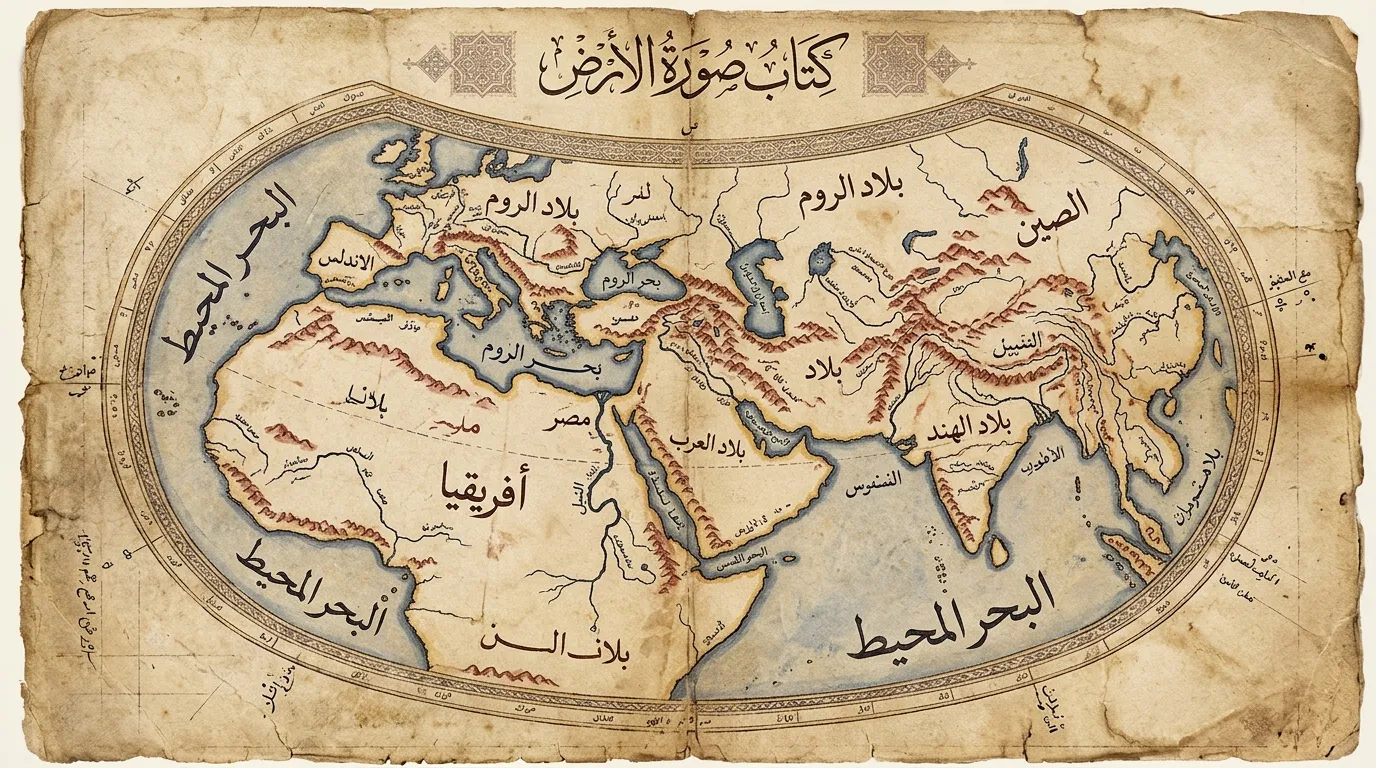
In geography, he produced the "Kitab Surat al-Ard" (The Image of the Earth), a major revision of Ptolemy's Geography. According to a critical study of the work, it was “an Arabic adaptation of Ptolemy geographical work... produced by al-Khwārizmī in about 830 A.D. under the patronage of the ‘Abbāsid Caliph al-Ma’mūn”. He corrected several of Ptolemy's errors and presented the coordinates for over 2,400 cities and localities in the known world. He also participated in a historic project to measure the circumference of the Earth by calculating the length of a degree of latitude.
A Legacy That Shaped the Modern World
Al-Khwarizmi's work was not just an intellectual exercise; it was designed to be practical. His Algebra included applications for trade, surveying, and the complex Islamic laws of inheritance. His systematic approach to problem-solving—breaking down complex problems into simple, repeatable steps—is the essence of the modern algorithm.
His legacy is a testament to the spirit of the Islamic Golden Age, a period of unparalleled intellectual curiosity and cross-cultural exchange. By preserving, synthesizing, and expanding upon the knowledge of earlier civilizations, Al-Khwarizmi and his contemporaries in the House of Wisdom helped ignite the flame of the European Renaissance and laid the groundwork for the Scientific Revolution. Today, every time we use a computer, balance a chemical equation, or solve an algebraic formula, we are, in a small way, walking in the footsteps of Al-Khwarizmi.
References
BBC Radio 3 – “Al-Khwarizmi” – Provides an overview of his life as a scholar in the House of Wisdom under Caliph al-Mamun.
Library of Congress – “The Compendious Book on Calculation by Completion and Balancing” – Confirms his role as a scholar in the House of Wisdom and explains the origin of the word “algebra” from al-jabr.
NASA Science – “How Algorithm Got Its Name” – Explains how the Latinization of Al-Khwarizmi's name gave English the word “algorithm.”
Archive.org – “A Critical Revision and Interpretation of Kitāb Ṣūrat al-Arḍ” – Details his geographical work Kitab Surat al-Ard, an adaptation of Ptolemy's Geography produced around 830 AD.


Join the conversation
Discussion0
Join the conversation. Sign in to leave a response or reply to comments.