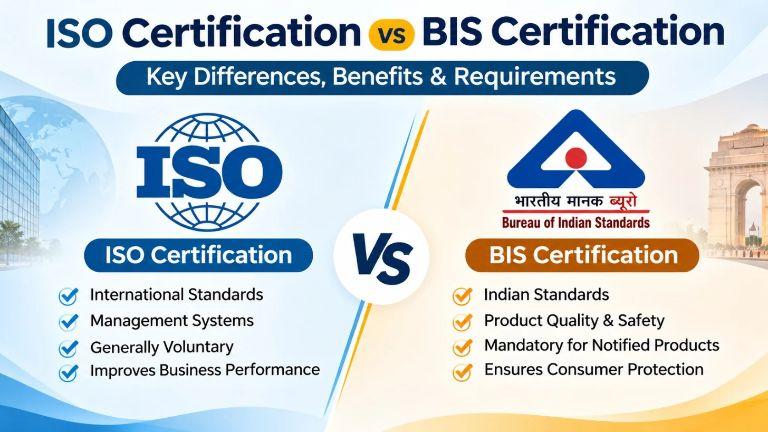
In today's competitive business environment, maintaining product quality, safety and customer satisfaction is essential for long-term success. ISO certification and BIS certification are two widely recognised certifications that help businesses demonstrate their commitment to quality and compliance.
However, many business owners get confused when choosing between ISO and BIS certification. While ISO certification generally focuses on international standards and management systems, BIS certification primarily ensures that products comply with applicable Indian standards.
Understanding the difference between ISO certification and BIS certification can help businesses select the right certification based on their industry, regulatory requirements and business objectives.
What Is ISO Certification?
ISO certification demonstrates that an organisation, process, product or service complies with the requirements of a relevant standard developed by the International Organization for Standardization (ISO). For any information contact a leading consultant of ISO certification in Delhi.
ISO management system certification helps businesses improve operational efficiency, maintain consistent quality, reduce risks and enhance customer satisfaction.
ISO develops international standards but does not directly issue certificates. Independent certification bodies conduct audits and provide certification to eligible organisations.
Common Types of ISO Certification
ISO 9001: Quality Management System (QMS)
ISO 14001: Environmental Management System (EMS)
ISO 45001: Occupational Health and Safety Management System
ISO 22000: Food Safety Management System
ISO 27001: Information Security Management System
ISO 13485: Medical Devices Quality Management System
ISO 50001: Energy Management System
Businesses of all sizes, including startups, manufacturers, service providers and multinational companies, can obtain relevant ISO certifications.
What Is BIS Certification?
BIS certification is a conformity assessment certification provided under the framework of the Bureau of Indian Standards (BIS), the national standards body of India.
BIS certification helps ensure that products meet prescribed Indian standards for quality, safety, reliability and performance.
It is mandatory for certain products notified by the Indian government, while other products may qualify for voluntary certification.
Major BIS Certification Schemes
ISI Mark Certification
Compulsory Registration Scheme (CRS)
Foreign Manufacturers Certification Scheme (FMCS)
BIS Hallmarking Scheme
Scheme X Certification
BIS certification is particularly important for manufacturers, importers and businesses dealing with products covered under mandatory Indian quality and safety regulations.
ISO Certification vs BIS Certification: Key Differences
The following table explains the major differences between ISO and BIS certification.
Basis | ISO Certification | BIS Certification |
|---|---|---|
Full form | International Organization for Standardization | Bureau of Indian Standards |
Recognition | International | Primarily India |
Issuing authority | Independent certification bodies | Bureau of Indian Standards |
Primary focus | Management systems and applicable international standards | Product quality, safety and Indian standards |
Legal requirement | Generally voluntary | Mandatory for notified products |
Applicability | Manufacturing and service industries | Primarily product manufacturers and importers |
Assessment | Management system audits or relevant conformity assessments | Product testing and scheme-specific assessments |
Validity | Typically three years for management system certification, subject to surveillance | Depends on the certification scheme |
Main objective | Improve business performance and consistency | Ensure product conformity and consumer safety |
Certification mark | Depends on the certification body and applicable rules | ISI Mark, BIS Standard Mark or other applicable marks |
Benefits of ISO Certification
Obtaining ISO certification can provide several advantages to businesses operating in domestic and international markets.
1. Improved Business Credibility
ISO certification demonstrates that an organisation follows recognised standards, helping build trust among customers, investors and business partners.
2. International Market Opportunities
ISO certification can help businesses meet international buyers' requirements and strengthen their export opportunities.
3. Better Operational Efficiency
Implementing ISO standards helps organisations improve internal processes, reduce unnecessary costs and minimise operational errors.
4. Increased Customer Satisfaction
A structured management system helps businesses deliver consistent products and services that meet customer expectations.
5. Government Tender Opportunities
Many government and private tenders specify relevant ISO certifications as eligibility or evaluation requirements.
Benefits of BIS Certification
BIS certification offers several benefits, particularly for product manufacturers and importers in India.
1. Regulatory Compliance
BIS certification helps manufacturers comply with mandatory product certification requirements wherever applicable.
2. Consumer Safety
Products are assessed against relevant Indian standards to help ensure quality, safety and performance.
3. Increased Customer Trust
Products carrying authorised BIS certification marks can gain greater consumer confidence.
4. Access to the Indian Market
BIS certification enables businesses to legally manufacture, import or sell products covered under applicable mandatory certification requirements.
5. Competitive Advantage
Certified products can help businesses differentiate themselves from competitors and strengthen their market reputation.
ISO Certification vs BIS Certification: Registration Process
Although both certifications involve conformity assessments, their application procedures are different.
ISO Certification Process
Select the appropriate ISO standard.
Choose a suitable certification body.
Implement the required management system.
Prepare documentation and conduct internal audits.
Complete the external certification audit.
Resolve identified nonconformities and obtain certification.
BIS Certification Process
Identify the applicable Indian Standard and certification scheme.
Submit the application and required documents.
Complete product testing as required.
Undergo factory inspection or assessment, wherever applicable.
Complete the evaluation process.
Obtain the applicable BIS licence or registration.
The exact procedure, certification cost and processing time depend on the selected standard, business activities and certification scheme.
Is ISO Certification or BIS Certification Mandatory in India?
ISO management system certification is generally voluntary in India. However, certain government tenders, contractual agreements and industry-specific requirements may make it necessary.
BIS certification is mandatory for products covered under applicable government notifications and Quality Control Orders (QCOs). Examples include certain electrical appliances, cement, steel products, toys and electronic equipment.
Businesses should check the latest mandatory product requirements on the official BIS website before manufacturing or importing products.
Can a Business Obtain Both ISO and BIS Certification?
Yes, a business can obtain both ISO and BIS certification.
For example, an electrical equipment manufacturer may obtain ISO 9001 certification to improve its quality management system while obtaining BIS certification to comply with applicable product safety standards.
Having both certifications can help businesses strengthen operational efficiency, regulatory compliance, customer confidence and market competitiveness.
Which Is Better: ISO Certification or BIS Certification?
The choice depends on your business requirements. ISO certification is suitable for organisations looking to improve management systems, operational performance and international credibility.
BIS certification is essential when products fall under mandatory Indian certification requirements.
Neither certification replaces the other because they serve different purposes.
Frequently Asked Questions (FAQs)
Is ISO certification equivalent to BIS certification?
No. ISO certification and BIS certification have different objectives, assessment procedures and compliance requirements.
Can ISO certification replace BIS certification?
No. ISO certification cannot replace mandatory BIS certification for regulated products.
Is BIS certification internationally recognised?
BIS certification primarily demonstrates conformity with Indian standards. Its acceptance in other countries depends on applicable regulations and recognition arrangements.
Can service-based companies obtain ISO certification?
Yes, service-based companies can obtain relevant ISO management system certifications.
Conclusion
Understanding ISO certification vs BIS certification is essential for businesses looking to improve quality, meet regulatory requirements and expand their market presence. While ISO certification helps organisations adopt internationally recognised standards, BIS certification focuses primarily on product conformity with Indian standards.
Businesses should evaluate their industry requirements and long-term objectives before selecting the appropriate certification.
Looking for professional ISO certification services in India? Raj Startup can assist your business with ISO certification consultancy, documentation and certification support.


Join the conversation
Discussion0
Join the conversation. Sign in to leave a response or reply to comments.